


Watch the full Daily Beltway report
Illinois Governor JB Pritzker Delivers Racially Charged ICE Accusations from Church Pulpit, Offers Zero Evidence
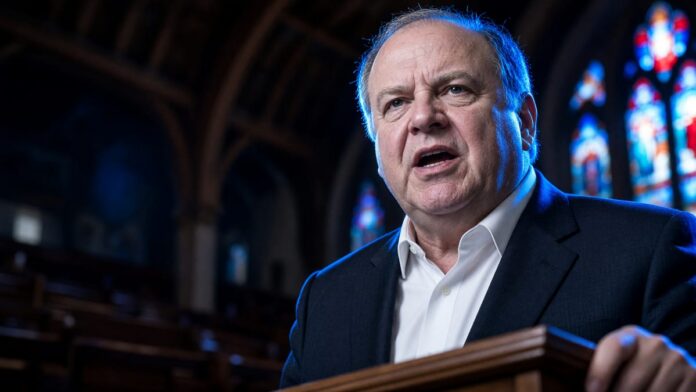
Illinois Governor JB Pritzker stood before a Rockford congregation and accused federal immigration enforcement of arresting innocent people based solely on skin color and accent. He offered no evidence, no specific incidents, and no data to support the inflammatory claim. He did, however, apologize for saying President Trump’s name in church.
Pritzker described operations involving masked personnel in unmarked vehicles targeting individuals because of their race. He stated that shootings of civilians continue under the current administration. The governor tied these accusations to cuts in food assistance, Medicaid, and potential changes to Medicare. He asserted that the right to vote has been undermined by a Supreme Court decision he attributes to Trump-appointed justices.
Governor JB Pritzker demagogues about ICE in a speech to a Rockford, IL, congregation and apologizes for saying the president's name in church:
"Masked troops in unmarked cars are still arresting innocent black people & brown people because of the color of their skin… They're… pic.twitter.com/hA8TNUkFsS
— Breitbart News (@BreitbartNews) August 31, 2026
During the speech, Pritzker paused and said, “I’m sorry to say his name in church. I should probably use code.” He continued by noting that even a reference to the number 47 would convey the same point. He described the Voting Rights Act ruling as diminishing representation for people of color in Congress.
Pritzker framed the overall situation as a reversal of progress. He claimed the arc of the moral universe is bending backward and that inhumanity and hardship now define actions taken in Washington. The speech occurred in a church setting, where the governor introduced his criticism of the president with an explicit apology for using the name.
The remarks focus on ongoing ICE activities under the Trump administration, which the governor portrayed as racially motivated. No evidence of such motivation appears in the statements themselves. The assertions rely on repeated claims about skin color and accent as the deciding factors. The address links immigration enforcement directly to voting rights and social program reductions without citing specific data or incidents from the Rockford area.
Conservative observers have noted that such rhetoric from state officials often seeks to portray routine law enforcement as systemic abuse. Pritzker’s choice to deliver these points from a pulpit and his self-conscious apology for naming the president underscore the political nature of the comments rather than a neutral policy discussion.
The governor’s language equates standard immigration arrests with racial targeting. This characterization overlooks the legal basis for federal operations targeting individuals present in the country unlawfully. ICE enforcement actions are predicated on immigration status, not race. Federal agents operate under legal authority to detain individuals who have violated immigration law, regardless of skin color or accent.
Pritzker’s claim that masked troops in unmarked cars are arresting innocent people distorts the reality of federal law enforcement operations. ICE agents conduct targeted enforcement based on intelligence and immigration violations. The use of unmarked vehicles and tactical gear is standard procedure in law enforcement, not evidence of racial animus.
The governor’s assertion that innocent people are being shot by ICE lacks any supporting detail. No specific incidents were cited. No names were given. No locations were identified. The claim stands as a sweeping accusation without substantiation.
Pritzker’s remarks also conflate immigration enforcement with broader political grievances. He tied ICE operations to cuts in social programs and changes in voting rights law. These are separate policy domains. Linking them without evidence suggests a rhetorical strategy rather than a factual analysis.
The governor’s self-conscious apology for saying Trump’s name in church reveals the theatricality of the moment. Pritzker was not delivering a sermon. He was delivering a political speech. The setting and the apology were choices designed to frame his criticism as moral rather than partisan.
The Voting Rights Act decision Pritzker referenced was a Supreme Court ruling on preclearance requirements. The Court held that the coverage formula in Section 4 of the Act was outdated. The decision did not eliminate the right to vote. It altered the process by which certain jurisdictions are subject to federal oversight.
Pritzker’s description of the decision as gutting the right to vote is hyperbolic. The ruling addressed administrative procedures, not voting eligibility. Mischaracterizing the decision serves a political narrative, not an accurate legal analysis.
The governor’s claim that the arc of the moral universe is bending backward is a rhetorical flourish borrowed from civil rights history. It is not a statement of fact. It is an emotional appeal designed to cast current policy as a regression.
Pritzker’s speech reflects a pattern among Democratic state executives who position themselves as resistance leaders against federal enforcement. The rhetoric is often heavy on accusation and light on evidence. The goal is to mobilize political support, not to provide accurate information.
Illinois remains a sanctuary state under Pritzker’s leadership. The state limits cooperation with ICE and restricts local law enforcement from assisting federal immigration authorities. Pritzker’s speech reinforces that posture while framing federal enforcement as morally illegitimate.
The governor’s accusations are serious. If masked troops are arresting innocent people based on race, that would be a violation of constitutional rights. If shootings are occurring without cause, that would be a criminal matter. Yet Pritzker offered no documentation, no case numbers, no victims’ names, and no calls for investigation.
The absence of evidence suggests the claims are political rather than factual. The speech was delivered to a receptive audience in a setting that discourages scrutiny. The result is a narrative that circulates without accountability.
Conservative critics note that Pritzker’s rhetoric serves to delegitimize lawful federal enforcement. By framing ICE operations as racist, he encourages non-cooperation and undermines the rule of law. The governor is not describing reality. He is shaping perception.
Pritzker’s speech in Rockford is a case study in how elected officials use inflammatory language to advance political goals. The setting, the apology, the accusations, and the absence of evidence all point to a coordinated message strategy. The facts of immigration enforcement are secondary to the emotional impact of the narrative.
The question for Illinois voters is whether they are satisfied with rhetoric or demand accountability. Pritzker made serious charges. He should be required to substantiate them. Until then, his speech remains what it appears to be: political theater disguised as moral witness.