

Vice President JD Vance Fires Back at Mexican Flag Protester: ‘Get Your Ass Over There’
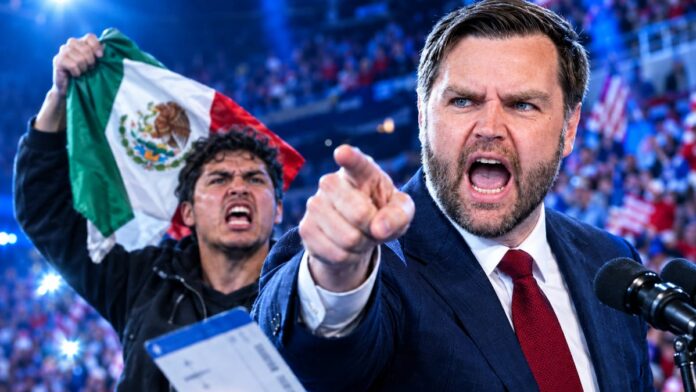
Vice President JD Vance delivered a blunt and unapologetic response to a protester who disrupted his rally by waving a Mexican flag. The incident, which unfolded during a public event, quickly turned into a defining moment as Vance addressed the interruption head-on with a challenge that sent the crowd into chants of USA.
Vance did not mince words. What the people at home missed is that we just had a protester interrupting us and waving the Mexican flag, he said. Well, my friend, if you love Mexico so much, get your ass over there, I’ll buy you the plane ticket. The response was immediate. Supporters erupted in approval, chanting USA repeatedly as the protester’s disruption was overwhelmed by the crowd’s energy.
JD Vance just absolute WIPED THE FLOOR with a leftist heckler who interrupted his rally waving a Mexican flag.
Vance didn’t hesitate: 'If you love Mexico so much, get your ass over there! I’ll buy the ticket!'
The crowd went completely WILD. Unbelievable energy! 🔥🇺🇸…
— Ryan Fournier (@RyanAFournier) September 11, 2026
The exchange highlighted a recurring tension at political rallies: the presence of individuals displaying foreign symbols while attending events centered on American leadership and policy. For Vance, the moment was an opportunity to reinforce a straightforward message about national loyalty and the expectation that public gatherings in the United States reflect support for the country hosting them.
This was not the first time a conservative figure has faced such a disruption. Over the past several years, rallies have occasionally been interrupted by demonstrators waving foreign flags or symbols, actions that many Americans view as provocations meant to undermine the event’s focus. Vance’s response aligned with a broader conservative stance: if allegiance lies elsewhere, relocation is a logical outcome.
The Vice President’s handling of the situation avoided extended debate. He acknowledged the disruption for the benefit of those watching remotely, delivered his pointed remark, and moved forward. The result was a clear affirmation of American identity without allowing the protester to dominate the narrative. This approach has proven effective in maintaining momentum at campaign-style stops, where energy and focus are critical.
Supporters present responded with visible enthusiasm. The chants of USA that followed Vance’s remarks underscored the crowd’s alignment with his message. For many in attendance, the moment crystallized larger debates over immigration, cultural loyalty, and the boundaries of acceptable protest conduct. It was a reminder that political events are not neutral spaces—they are gatherings of individuals who share a common allegiance, and challenges to that allegiance are met with swift rejection.
The timing of the rally added another layer of context. The event took place on a day when national attention also turned to remembrance of past attacks on American soil, reinforcing themes of patriotism and resilience. Vance’s response to the protester fit naturally into that broader atmosphere, serving as a reminder that the prioritization of American interests remains non-negotiable.
Critics of such responses argue that they inflame tensions and discourage open discourse. Supporters counter that disruptions like waving a foreign flag at a domestic political event are not acts of discourse—they are provocations designed to hijack the message. Vance’s supporters see his willingness to confront such behavior as a strength, not a flaw.
The incident also underscored Vance’s reputation for engaging challengers without hesitation. Since taking office, he has built a public image around direct communication and a refusal to back down from confrontation. This latest exchange reinforced that image, turning a potential distraction into a moment that rallied his base.
The protester’s disruption was brief, but its impact will likely extend beyond the event itself. Video of the exchange has circulated widely, with supporters praising Vance’s directness and critics accusing him of insensitivity. For Vance, the reaction is predictable and immaterial. His base values leaders who defend American identity without apology, and this moment delivered exactly that.
The broader question remains: what role should displays of foreign allegiance play at domestic political events? For conservatives, the answer is clear. Political rallies in the United States should reflect support for the United States. Anything less is a distraction at best and a provocation at worst. Vance’s response embodied that principle, and the crowd’s reaction affirmed it.
As the Vice President continues his public appearances, moments like this will likely recur. They are flash points in a larger cultural battle over national identity, sovereignty, and the expectations Americans hold for those who participate in civic life. Vance’s willingness to address those flash points directly, without hedging or equivocation, is precisely what his supporters demand.
The rally continued after the interruption, but the protester’s disruption will be remembered far longer than the speech itself. That is the nature of such moments—they distill complex debates into a single exchange, and Vance’s response left no ambiguity about where he stands. For those in attendance and those watching from home, the message was unmistakable: American events are for Americans, and loyalty matters.