

Democrats Won Midterms on Affordability—Then NYC Passed a Bill That Adds Five Dollars to Every Amazon Order
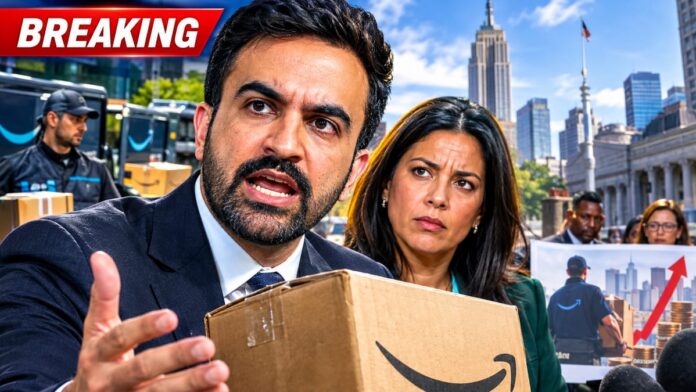
Democrats campaigned on affordability to win the midterms. New York City Democrats under Mayor Zohreh Mamdani are now advancing a measure that could raise the price of every Amazon delivery by as much as five dollars. The Delivery Protection Act is moving through the City Council with at least thirty-four co-sponsors. It would require last-mile delivery operators to secure a city license and hire their drivers and warehouse workers directly instead of relying on third-party contractors. It also imposes annual safety training requirements, with daily fines of one thousand dollars for violations.
The legislation is framed as a worker-safety initiative. Amazon has warned that the shift to direct employment would drive up operational costs and pass those expenses directly to customers. Independent delivery businesses echo that concern, stating that ten thousand jobs stand at risk if the measure becomes law. One industry representative stated there is a freight train coming if this passes the way it does, and people do not understand the unintended consequences. There are so many second-order effects about to happen, and all they want is a seat at the table to raise safety standards without the direct-employment mandate that would decimate the entire industry.
🚨🇺🇸 Democrats won the Midterms on an "affordability" message. Was that all complete bullsh*t??
Mamdani's NYC Democrats are set to approve a bill that could add up to $5.00 to EVERY Amazon order.
The so-called "Delivery Protection Act" would force Amazon to hire its contracted…
— Mario Nawfal (@MarioNawfal) November 23, 2026
Negotiations between the City Council and Amazon remain ongoing, yet the bill already holds enough support to clear the simple majority needed for passage. Mayor Mamdani responded to Amazon’s cost warning by labeling it greed on social media. The contrast with the recent midterm messaging could not be sharper. Voters heard repeated pledges that Democrats would focus on lowering everyday expenses, only to see one of the party’s largest strongholds prepare rules that would make routine online purchases more expensive.
The proposed changes target Amazon’s subcontractor model in the final leg of deliveries, a system that has allowed flexible operations and lower overhead. Forcing direct employment would eliminate that flexibility and add layers of compliance that smaller operators say they cannot absorb without raising rates. The result, according to those in the industry, would be higher prices for consumers and fewer opportunities for the very workers the bill claims to protect.
Nothing in the measure addresses how these added expenses would be offset. Instead, the focus stays on licensing, direct hiring, and training mandates that carry automatic penalties. With the City Council positioned to move forward, New Yorkers could soon see the five-dollar surcharge appear on checkout screens for even the smallest orders. That outcome sits uneasily beside campaign promises that affordability would take priority once Democrats secured victories at the polls.
The bill requires last-mile delivery operators to obtain a city license before conducting business in New York. Operators must directly employ all delivery drivers and warehouse workers rather than using third-party contractors. Annual safety training is mandatory, and violations result in fines of one thousand dollars per day. The direct-employment requirement is the provision drawing the most resistance from Amazon and independent delivery businesses.
Amazon launched a campaign warning New Yorkers that the legislation could add as much as five dollars to the cost of each delivery in the city. Independent delivery businesses say ten thousand jobs are at risk. The industry argues that the direct-employment mandate would force operators to absorb costs they cannot sustain, leading to job cuts and service reductions. The bill’s supporters dismiss those warnings as corporate fearmongering designed to protect profit margins.
Mayor Mamdani posted on social media calling Amazon’s warning about the five-dollar cost per order greed. That response signals the administration’s unwillingness to negotiate on the direct-employment mandate. The City Council and Amazon both say negotiations are ongoing, but the bill has at least thirty-four co-sponsors. That is more than enough to pass the simple majority required for passage.
The timing is awkward for Democrats who built their midterm campaigns on affordability messaging. Voters in key swing districts heard promises that Democratic leadership would focus on lowering costs for working families. New York City is now advancing a measure that would do the opposite, adding a surcharge to one of the most common consumer transactions in urban America. The disconnect between campaign rhetoric and governing reality is stark.
The Delivery Protection Act represents a test case for how far progressive cities are willing to go in pursuit of labor reforms even when those reforms carry direct costs for the voters they claim to represent. If the bill passes and the five-dollar surcharge materializes, it will become a concrete example of Democratic policy making everyday life more expensive at the precise moment the party promised to do the opposite.
The measure is expected to come to a vote in the coming weeks. If it passes, New York City will become the first major city in the United States to mandate direct employment for last-mile delivery workers. Other progressive cities are watching closely. The outcome in New York could set a precedent that reshapes delivery operations nationwide, with corresponding cost increases passed on to consumers in every market that follows the city’s lead.
Sources
- Original post: Mario Nawfal (@MarioNawfal) on X
- Related posts reviewed for this report:
- Ryan Fournier (@RyanAFournier) on X, Nov 23, 2026
- Myrna 𝕏 (@GigaBeers) on X, Nov 23, 2026
- VOZ (@Voz_US) on X, Nov 23, 2026
Posts on X are shown as published by their authors; claims in them are attributed, not independently confirmed unless the article says so. If an embedded post does not load, these links open the originals.