


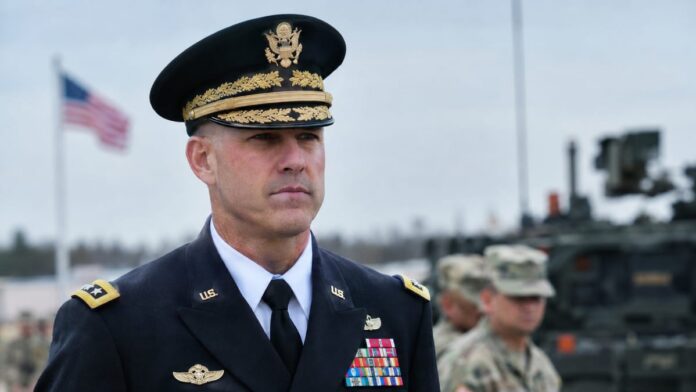
President Trump has formally nominated Gen. Christopher LaNeve to serve as the Army’s chief of staff, the service’s top uniformed job, which LaNeve has held on an acting basis since April. The Senate received the nomination Monday, Nov. 16, and referred it to the Armed Services Committee as PN1509.
The administration also nominated Lt. Gen. Marcus Evans, the director of the Army Staff, to succeed LaNeve as vice chief of staff. Both picks need Senate confirmation in the final weeks of the current Congress.
What the nominations do
The Senate’s list of military nominations in committee shows LaNeve’s nomination in the grade of general, filed with general-officer nominations for Evans and Lt. Gen. Patrick D. Frank, all referred on Nov. 16. Confirmation would make LaNeve the Army’s permanent chief and end the stretch since April in which he has filled both of the service’s top officer posts.
LaNeve is a 36-year infantry officer who has commanded the 7th Army Training Command in Germany, the 82nd Airborne Division at Fort Bragg, N.C., and Eighth Army in South Korea, Stars and Stripes reported. He was confirmed as vice chief of staff in January after serving as Hegseth’s top military adviser.
Evans is also an infantry officer with combat time in Afghanistan and Iraq. He previously commanded the 25th Infantry Division in Hawaii and the 75th Ranger Regiment, and he has been director of the Army Staff since September 2025.
Why it matters
The Army has gone months without confirmed leaders at the top. Defense Secretary Pete Hegseth fired Gen. Randy George as chief of staff on April 2, and Army Secretary Dan Driscoll resigned in early September. Acting Secretary Adam Telle has led the civilian side since then, and no permanent secretary has been nominated.
As acting chief, LaNeve rolled out “The Army Azimuth,” which focuses the service on future wars on a tech-dominated battlefield and on defending the homeland, and last month he issued updated guidance titled “How the Army Fights.” Daily Beltway analysis: a confirmed chief would give that modernization push a settled uniformed leader at a time when the Army’s civilian post is still filled on an acting basis.
“That should never ever be a fair fight,” LaNeve said of soldiers’ missions in a keynote at the Association of the U.S. Army convention in Washington in October. “The speed, the precision and lethality soldiers require to execute these missions demand cutting-edge technology,” he said, adding that he and Telle intend to deliver it at scale.
The other side
The nomination could meet resistance. Sen. Roger Wicker, R-Miss., chairman of the Armed Services Committee, acknowledged in August that there was at least some bipartisan opposition to LaNeve among committee members. The Wall Street Journal identified Sen. Joni Ernst, R-Iowa, a retired Army lieutenant colonel, that month among Republicans opposing him.
Senators also pressed Hegseth over George’s removal at a May 1 hearing, where he declined to give specifics. “We needed new leadership,” Hegseth told senators several times. Ernst was among the members who voiced disappointment with the decision.
What’s next
The Armed Services Committee would need to act on PN1509 before the full Senate can vote. It was not clear Tuesday when the Senate would take up LaNeve’s nomination, or whether it would come up before a new Democratic-majority Senate is sworn in on Jan. 3.