


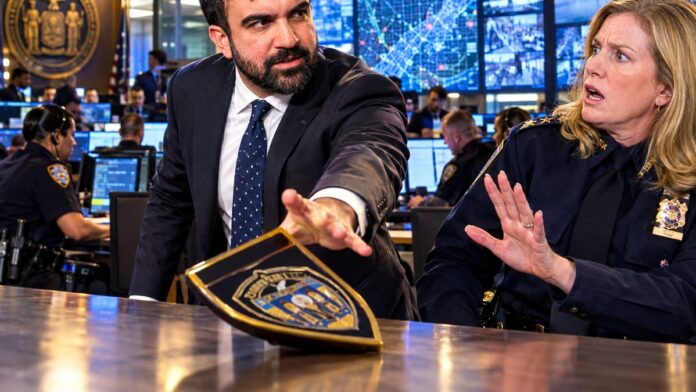
New York City Mayor Zohran Mamdani Formally Disbands NYPD Strategic Response Group
New York City Mayor Zohran Mamdani has formally disbanded the NYPD Strategic Response Group, eliminating the elite 500-officer unit responsible for counterterrorism and protest management. The decision fulfills a campaign promise and shifts protest response to a new civilian division under the Mayor’s Office of Community Safety, stripping police of specialized crowd-control capabilities at a time when urban disorder remains a persistent threat.
Mamdani announced the move in a public statement, declaring that counterterrorism enforcement and protest response are distinct priorities that should be handled separately. He framed the decision as a matter of protecting constitutional rights while maintaining community safety, arguing the two goals are intertwined rather than in conflict. The Strategic Response Group had been tasked with both missions since its formation, deploying trained officers equipped to handle everything from t*rrorism threats to large-scale demonstrations.
🚨 JUST IN: Ugandan Mayor Mamdani is FORMALLY DISBANDING the NYPD's Strategic Response Group, the elite unit that handles counterterrorism AND protests
This is betrayal and a recipe for disaster!
Protests will now be handled by a new civilian division with NO weapons and NO…
— Eric Daugherty (@EricLDaugh) November 16, 2026
The new Community Dialogue and De-escalation Division will be staffed entirely by civilians without weapons or arrest powers. According to Mamdani, the division will prepare for and respond to protests through dialogue and engagement rather than enforcement. A separate First Amendment support team within the police department, called FAST, will continue some liaison work during the transition, but trained officers will only be called in to make arrests when necessary, including in cases of civil disobedience.
Mamdani explicitly ruled out the use of long guns, tear gas, kettling, or pepper spray as crowd-control tactics during First Amendment activities. He emphasized that overall NYPD headcount would remain unchanged despite the dissolution of the SRG, claiming the reforms accomplish key changes called for by Councilmember Osei’s CURB Act, legislation Mamdani said he is proud to support.
The Strategic Response Group was created to address both t*rrorism threats and large-scale public disorder, fielding roughly 500 highly trained officers capable of rapid deployment. Its dissolution removes a specialized capability that previously allowed the city to respond to volatile events with trained personnel equipped for enforcement. Critics view the creation of an unarmed civilian unit as a fundamental weakening of the city’s ability to maintain order during protests that escalate into riots or when t*rrorism-related threats emerge amid public gatherings.
The decision contradicts earlier assurances from city officials that the unit would not be disbanded. In March, Police Commissioner Jessica Tisch told the City Council her talks with Mamdani were not aimed at disbanding the unit, suggesting the mayor’s campaign pledge would not translate into immediate action. Tisch’s statement now appears to have been either a miscommunication or a deliberate misdirection as the administration moved forward with the plan.
Conservative observers see the policy as prioritizing activist demands over proven law enforcement practices, leaving New York more exposed at a time when urban security challenges remain acute. The emphasis on restricting standard crowd-control tools raises concerns about how authorities will respond if protests escalate into violence or property destruction. Without the ability to deploy less-lethal tools like tear gas or pepper spray, police may face a choice between allowing disorder to continue unchecked or resorting to physical arrests that carry greater risk of injury and confrontation.
Mamdani, New York City’s first Muslim mayor, has aligned his administration with progressive reforms that subordinate operational effectiveness to ideological goals. The decision to strip the NYPD of a dedicated counterterrorism and protest unit reflects a broader approach that deliberately limits police options while handing key public safety functions to civilians lacking enforcement authority. The result is a structure that removes deterrence and response capabilities in favor of dialogue and de-escalation, a framework that assumes cooperation from crowds that may have no intention of complying.
The move comes as cities across the republic continue to grapple with the consequences of similar reforms enacted in the wake of 2020’s riots and protests. Jurisdictions that limited police crowd-control tools or restricted enforcement tactics have experienced prolonged disorder during demonstrations, with property damage, assaults on officers, and disruptions to public safety becoming routine outcomes. New York’s decision to disband the SRG and replace it with unarmed civilians follows that pattern, trading proven enforcement capacity for an experiment in conflict resolution that has failed in other cities.
The Strategic Response Group’s counterterrorism mission will now fall to other units within the NYPD, fragmenting a capability that was designed to address both threats simultaneously. Protests and large public gatherings have long been recognized as potential targets for t*rrorism, requiring personnel who can assess security risks while managing crowd dynamics. Separating those functions removes a layer of integrated response that served a clear operational purpose, leaving the city more vulnerable to threats that exploit public events.
Mamdani’s decision to ban long guns, tear gas, kettling, and pepper spray during First Amendment activities limits the tools police can use to restore order when protests turn violent. Kettling, the practice of containing crowds to prevent dispersal and regrouping, has been a standard tactic for managing large-scale disorder. Tear gas and pepper spray provide less-lethal options for dispersing crowds that refuse lawful orders to leave. Long guns offer a visible deterrent and response capability when protests attract armed agitators or credible threats emerge. Removing all of these tools leaves police with fewer options and increases the likelihood that confrontations will escalate to physical force.
The creation of a civilian division under the Mayor’s Office of Community Safety shifts accountability away from the police department and places protest management in the hands of personnel with no arrest powers and no enforcement training. If a protest turns violent, those civilians will have no authority to detain offenders, secure a perimeter, or take enforcement action. They will be reliant on calling in trained officers, introducing delays that allow disorder to spread and creating confusion about who is in command during a rapidly evolving incident.
The policy reflects a fundamental misunderstanding of what happens when enforcement authority is removed from public safety operations. Dialogue and engagement are effective tools when participants are willing to cooperate, but they offer no solution when crowds refuse to comply with lawful orders, when agitators use protests as cover for violence, or when credible threats require immediate action. New York’s experiment in unarmed civilian protest management will test whether de-escalation rhetoric can substitute for enforcement reality, and the evidence from other cities suggests it cannot.
Mamdani’s approach prioritizes ideological commitments over the practical requirements of maintaining order in America’s largest city. The decision to disband the SRG and restrict police crowd-control tools reflects a willingness to accept greater risk in pursuit of progressive reform, gambling that future protests will remain peaceful and that t*rrorism threats will not exploit the gaps the policy creates. That gamble leaves New Yorkers more exposed and law enforcement less prepared for the scenarios the Strategic Response Group was created to address.
Sources
- Original post: Eric Daugherty (@EricLDaugh) on X
- Related posts reviewed for this report:
- Breaking911 (@Breaking911) on X, Nov 16, 2026
- Gunther Eagleman™ (@GuntherEagleman) on X, Nov 16, 2026
- TheBlaze (@theblaze) on X, Nov 16, 2026
Posts on X are shown as published by their authors; claims in them are attributed, not independently confirmed unless the article says so. If an embedded post does not load, these links open the originals.