

Newly Elected Democrat Refuses to Call Iran an Adversary, Blames America for Conflict
Newly elected Democratic Representative Adam Hamawy refused multiple times to call Iran an adversary during a CNN interview, instead arguing that America pushed the regime into conflict and should pursue friendship rather than confrontation.
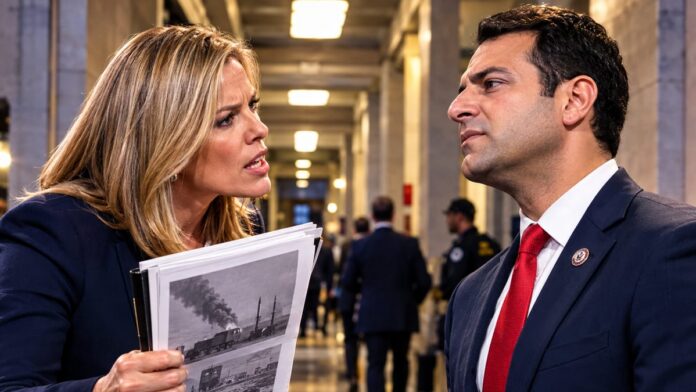
The exchange, which has drawn sharp criticism from conservative observers and foreign policy hawks, occurred when CNN anchor Pamela Brown pressed Hamawy directly on whether he views Iran as an adversary to the United States.
Insane exchange. Newly elected Democrat Adam Hamawy refuses to call Iran an adversary.
BROWN: Do you see Iran as the adversary?
HAMAWY: "We pushed them into a fight"
BROWN: But are they the adversary?
HAMAWY: "We should be making friends"
BROWN: They've been saying "death to… pic.twitter.com/m20jdgDIp7
— RNC Research (@RNCResearch) November 10, 2026
Hamawy’s response: America pushed Iran into a fight, and both nations need to step back.
When Brown asked a second time whether Iran is the adversary, Hamawy replied that Washington is making adversaries when it should be making friends.
Brown then reminded the congressman-elect that Iran has chanted “death to America” for decades. Hamawy countered that America has been saying “death to Iran” for decades as well, drawing a moral equivalence between official U.S. policy and the explicit anti-American ideology promoted by Tehran’s theocratic regime.
The anchor pushed further, noting that Iran has killed a lot of Americans. Hamawy acknowledged the deaths but again drew a parallel: America has killed a lot of them as well.
Pressed a third time on whether he sees Iran as an adversary, Hamawy maintained his position, stating that Washington is pushing Iran into a fight when America has the leverage to bring the regime to the negotiating table.
Hamawy cited the Obama administration’s diplomatic approach to Iran, suggesting that similar engagement strategies could succeed again if the United States deployed economic and diplomatic pressure rather than military options. He argued that America possesses sufficient power to create friends in the region and bring peace if the nation chooses that path.
The congressman-elect’s comments reflect a strain of foreign policy thinking within the Democratic Party that emphasizes de-escalation and diplomatic engagement over confrontational positioning. His refusal to characterize Iran as an adversary—despite the regime’s explicit hostility, support for t*rrorist organizations, and involvement in attacks that have killed Americans and targeted U.S. allies—represents a significant departure from the bipartisan consensus that has defined Iran policy for decades.
Conservative critics have seized on the exchange as evidence of a troubling worldview among some Democrats, one that treats long-standing adversarial relationships as mutual misunderstandings rather than as products of regime ideology and stated objectives.
Iran’s government has provided funding, weapons, and training to proxy forces across the Middle East, including t*rrorists in Lebanon, t*rrorists in Gaza, and t*rrorists rebels in Yemen. The regime has orchestrated attacks on U.S. military personnel in Iraq, plotted assassinations on American soil, and continues to develop ballistic missile capabilities while threatening Israel and Sunni Arab states aligned with Washington.
The Islamic Republic’s Supreme Leader and senior officials have repeatedly declared that the regime’s ultimate goal is the destruction of Israel and the expulsion of American influence from the region. The phrase “death to America” is not a rhetorical flourish but a core tenet of the regime’s revolutionary ideology, chanted at official state events and taught in schools.
Hamawy’s assertion that America has been saying “death to Iran” for decades does not reflect official U.S. government rhetoric or policy. While American leaders have opposed the Iranian regime and imposed sanctions, no administration has adopted “death to Iran” as a policy slogan or ideological rallying cry.
The comparison also sidesteps the nature of deaths on both sides. Americans killed by Iran include service members targeted by Iranian-supplied improvised explosive devices in Iraq, personnel killed in the 1983 Beirut barracks bombing orchestrated by Iranian proxies, and victims of Iranian-backed militia attacks. Iranian deaths in conflict with the United States have occurred in the context of counterterrorism operations, defense of allies, and responses to Iranian aggression.
By framing the relationship as symmetrical and suggesting that America bears primary responsibility for the adversarial dynamic, Hamawy’s statements illustrate a worldview that rejects the premise that some regimes are fundamentally hostile to American interests and values.
Conservative observers have long expressed concern about Democratic approaches to Iran that prioritize engagement and restraint. Critics argue that such policies embolden a regime that continues to develop weapons, support regional proxies, suppress domestic dissent, and threaten American allies.
The Obama administration’s Joint Comprehensive Plan of Action, which Hamawy referenced as a model, lifted sanctions in exchange for temporary limits on Iran’s nuclear program. Critics argued that the deal provided the regime with billions of dollars in sanctions relief while failing to address its ballistic missile development, support for t*rrorism, or regional destabilization.
The Trump administration withdrew from the agreement in 2018 and reimposed sanctions under a maximum pressure campaign designed to force Tehran back to the negotiating table for a broader deal addressing all aspects of Iranian aggression. The Trump team also ordered the strike that killed Iranian General Qasem Soleimani, the commander of the Quds Force responsible for orchestrating attacks on Americans across the Middle East.
Hamawy’s comments suggest that he views the Trump administration’s approach as counterproductive and believes that a return to Obama-era diplomatic engagement offers the best path forward.
The exchange raises questions about how newer members of Congress view traditional American security interests and the nature of threats posed by hostile regimes. Hamawy’s refusal to call Iran an adversary, even when confronted with the regime’s explicit anti-American rhetoric and actions, signals a willingness to redefine foundational assumptions about American foreign policy.
For conservatives, the interview represents a troubling example of progressive foreign policy thinking that treats American power as the problem rather than the solution, and that prioritizes diplomatic engagement with adversaries over support for allies and deterrence of aggression.
As Hamawy prepares to take office, his views on Iran will likely face scrutiny from colleagues on both sides of the aisle, particularly as the Trump administration navigates renewed tensions with Tehran over its nuclear program, regional proxy activities, and threats against Israel.
The question for voters in Hamawy’s New Jersey district is whether they elected a representative who will defend American interests abroad or one who will blame America first when confronted with hostile regimes that have declared themselves enemies of the republic.
Sources
- Original post: RNC Research (@RNCResearch) on X, Nov 10, 2026
- Related posts reviewed for this report:
- Curtis Houck (@CurtisHouck) on X, Nov 10, 2026
- Ryan Fournier (@RyanAFournier) on X, Nov 10, 2026
- Erikaaa (@ErikaCA47) on X, Nov 10, 2026
Posts on X are shown as published by their authors; claims in them are attributed, not independently confirmed unless the article says so. If an embedded post does not load, these links open the originals.