


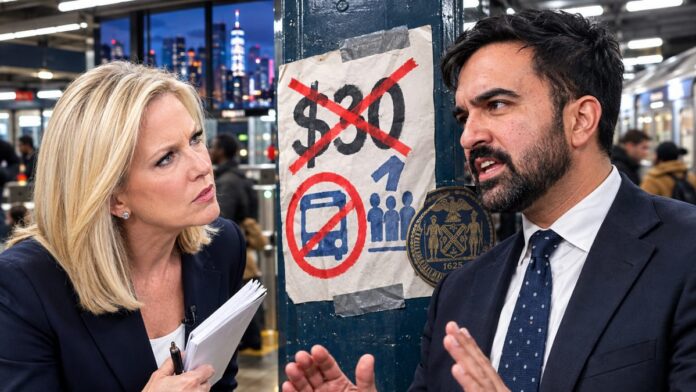
NYC Minimum Wage Promise and Free Bus Pledge Collapse as Fox News Grills Socialist Mayor
Zohran Mamdani’s ambitious campaign agenda hit a wall of accountability during a Fox News interview that exposed the distance between progressive promises and governing reality ten months into his New York City mayoral term.
Shannon Bream confronted the socialist mayor with a list of unfulfilled commitments that defined his campaign: a thirty-dollar-per-hour minimum wage for the city, free public bus service for all New Yorkers, the arrest of Israeli Prime Minister Benjamin Netanyahu, and the dismantling of portions of the NYPD. None have materialized.
Shannon Bream just utterly DISMANTLED Socialist NYC Mayor Zohran Mamdani on Fox News.
Free buses? FAILED.
$32 minimum wage? FAILED.
Defunding the NYPD? FAILED.Socialism always collapses the second it hits reality. pic.twitter.com/JZnbF5apeU
— Ryan Fournier (@RyanAFournier) November 8, 2026
The Fox News host framed the core tension directly. Democrats and Republicans both find it easy to make sweeping promises during campaigns, she noted, before pressing Mamdani on whether he had run into the reality of actually governing a city as complex as New York.
The free bus promise drew particular attention. Bream said viewers had specifically requested she ask about it, highlighting how the pledge had resonated during the campaign but vanished once Mamdani took office. The thirty-dollar minimum wage, another signature proposal, remains equally unrealized.
Mamdani resisted characterizing the unfulfilled promises as failures. Governing is difficult, he acknowledged, but that difficulty should not discourage officials from pursuing ambitious goals. He pivoted to what he described as accomplishments in child care policy.
Bream challenged even those claims. While Mamdani promoted universal child care expansion as a major achievement, the actual rollout has been limited. When the mayor highlighted providing child care for two thousand dollars annually, the interviewer corrected the framing—noting that the promise had been for comprehensive coverage from infancy through age five, not a narrow program with two thousand slots.
Mamdani defended the incremental approach, arguing that the city had delivered child care at multiple price points—five thousand, four thousand, three thousand, and now two thousand dollars annually—and that expansion would continue. He referenced receiving 1.2 billion dollars for child care on his eighth day in office and claimed the program would receive an additional twelve thousand dollars annually going forward, with the governor committed to further expansion.
Beyond the flagship unfulfilled promises, Mamdani attempted to redirect the conversation toward other accomplishments: filling 220,000 potholes across the city and executing what he called the largest labor enforcement action in New York City history, recovering 130 million dollars from DoorDash for 260,000 workers.
His closing argument reframed the timeline for promise-keeping. Some promises are fulfilled on day one, he said, others on day 365, and still others in year three. The work continues across the entire term.
The interview laid bare what conservatives view as a fundamental problem with progressive governance: candidates make expansive commitments that sound appealing on the campaign trail but prove difficult or impossible to implement once they assume office and confront budget constraints, legal limitations, and bureaucratic reality.
The specific promises Mamdani campaigned on represent core progressive policy goals—free public transit, dramatically increased minimum wages, police defunding, and international prosecutions—that have proven challenging to execute even in a politically sympathetic city like New York.
Bream’s questioning suggested skepticism about whether filling potholes and creating limited child care slots represent the transformative change Mamdani promised voters. The persistent focus on unfulfilled campaign commitments highlighted the gap between what progressive candidates pledge and what they actually deliver.
The Fox News segment comes as Democrats prepare to assume control of Congress following their midterm victory, raising questions about whether newly elected progressive lawmakers will encounter similar challenges when attempting to implement their own sweeping campaign promises at the federal level.
Mamdani’s defense—that promises unfold over time and that incremental progress counts as success—reflects a governing philosophy that prioritizes gradual expansion over immediate transformation. Whether New York City voters accept that framing or demand faster action on the commitments that won their support remains to be seen.
The interview underscored a broader conservative argument: that progressive policy agendas often collapse when they encounter the constraints of real-world governance, and that voters should scrutinize whether candidates can actually deliver on the promises that got them elected.
Sources
- Original post: Ryan Fournier (@RyanAFournier) on X, Nov 8, 2026
- Related posts reviewed for this report:
- Fox News (@FoxNews) on X, Nov 6, 2026
- Fox News (@FoxNews) on X, Nov 8, 2026
- RNC Research (@RNCResearch) on X, Nov 8, 2026
Posts on X are shown as published by their authors; claims in them are attributed, not independently confirmed unless the article says so. If an embedded post does not load, these links open the originals.