


Houston Mayor Blocks Police Contact With Immigration Authorities
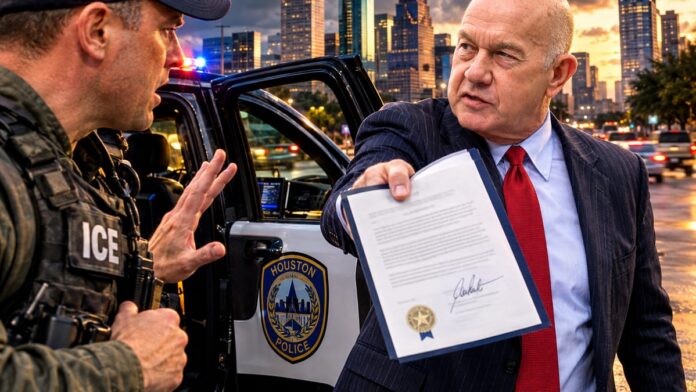
Houston Mayor John Whitmire has signed an executive order directing the Houston Police Department to cease contacting Immigration and Customs Enforcement, a sanctuary city policy shift that follows recent Democratic electoral gains in Texas.
The executive order instructs Houston Police Chief and HPD personnel to change department policy regarding contact with ICE. Whitmire announced the directive publicly, framing the policy as necessary to reduce fear in Houston communities.
Houston Mayor John Whitmire says HPD policy changes coming after Democrats' wins in Texas
"I have signed an executive order directing HPD to no longer contact ICE, helping reduce fear in our communities." pic.twitter.com/qHNifEkPGh
— Bruce Snyder (@realBruceSnyder) November 6, 2026
“This morning I have directed the chief and HPD through an executive order that we will change our policy in regarding contact with ice,” Whitmire stated. “I do this to begin a healing process, reduce fear and anxiety across our community.”
The timing of the announcement appears connected to a broader political context of Democratic victories in Texas. While the scope of recent Democratic wins was not detailed, the move signals that Houston’s governance is increasingly aligned with progressive immigration policy rather than enforcement-centered approaches.
The decision to restrict police-ICE contact represents a divergence from federal immigration enforcement policies and cooperation frameworks that have been pursued under Republican state leadership and the Trump administration. Proponents of such restrictions argue they reduce distrust between immigrant communities and law enforcement. Critics contend they compromise public safety by preventing coordination on individuals with criminal histories or immigration violations.
The executive order’s practical implications for HPD operations remain to be fully detailed. Key questions include whether the restriction applies to all ICE contacts, specific circumstances, or particular offenses. The policy also raises questions about how it intersects with state and federal law enforcement obligations and whether it includes exceptions for serious criminal offenses or national security concerns.
From a conservative policy perspective, restrictions on local law enforcement cooperation with federal immigration authorities represent a continuation of sanctuary policies that limit immigration enforcement capabilities. Such policies can prevent federal authorities from detaining individuals with immigration violations, even when those individuals have criminal records or pose public safety risks.
The Houston Police Department’s relationship with ICE has been a subject of debate within the city. Immigration advocacy groups have previously criticized cooperation between local police and federal immigration authorities, while law-and-order advocates have supported such coordination as a tool for comprehensive public safety.
Whitmire’s move signals the direction of governance in Houston as Democratic influence in Texas urban centers continues to expand. The decision to prioritize what the mayor frames as community healing over immigration enforcement cooperation illustrates how local policy in major Texas cities increasingly reflects progressive priorities.
The order takes effect through executive action, meaning it bypasses the city council legislative process and can be implemented immediately by the mayor’s authority. This approach allows Whitmire to move swiftly on the issue without requiring additional political consensus, though such executive actions can face legal challenges or be reversed by subsequent administrations.
Texas has long been a Republican stronghold, but major cities like Houston have seen increasing Democratic support in recent election cycles. The policy shift in Houston reflects the political realignment occurring in urban Texas, where Democratic leadership is pursuing immigration policies that diverge from state and federal enforcement frameworks.
The restriction on police-ICE contact could have significant implications for immigration enforcement in Houston, the nation’s fourth-largest city. Without local law enforcement cooperation, federal immigration authorities may face increased difficulty identifying and detaining individuals with immigration violations.
As Houston grapples with immigration policy at the local level, this directive will likely prompt discussion about the balance between community trust and law enforcement effectiveness, and whether limiting ICE contact improves or complicates efforts to maintain public safety in a major American city.
Sources
- Original post: Bruce Snyder (@realBruceSnyder) on X, Nov 6, 2026
- Related posts reviewed for this report:
- Kyle Becker (@kylenabecker) on X, Nov 6, 2026
- Breanna Morello (@BreannaMorello) on X, Nov 6, 2026
- Eric Daugherty (@EricLDaugh) on X, Nov 6, 2026
Posts on X are shown as published by their authors; claims in them are attributed, not independently confirmed unless the article says so. If an embedded post does not load, these links open the originals.