


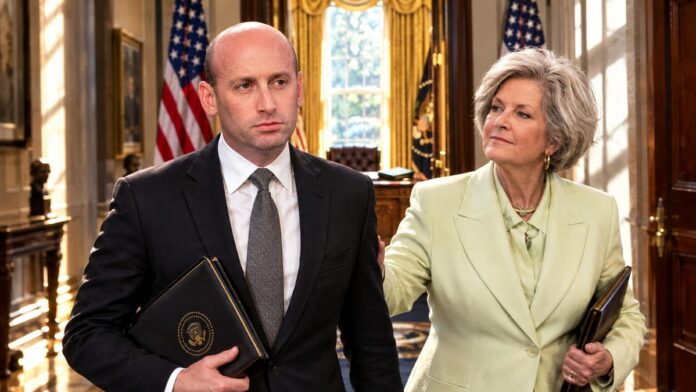
Stephen Miller Assumes White House Chief of Staff Role as Susie Wiles Transitions to Trump Political Operation
President Trump announced Monday afternoon that Stephen Miller will assume the duties of White House chief of staff beginning November 9, elevating one of his longest-serving advisors to the most powerful operational role in the executive branch.
Miller, who currently serves as deputy chief of staff, will replace Susie Wiles, who is transitioning to lead the Trump Political Operation. Trump described Miller as one of his most trusted advisors and expressed confidence in the transition.
🔥🚨 IT’S OFFICIAL: Stephen Miller will assume the duties of White House Chief of Staff on Monday.
President Trump announced the move this afternoon and confirmed Miller starts in the role on November 9.
Susie Wiles is shifting to the Trump Political Operation after Trump… pic.twitter.com/p1KfOBisgL
— The Patriot Oasis™ (@ThePatriotOasis) November 6, 2026
The announcement came directly from President Trump this afternoon. Miller starts in the role Monday. Trump praised Wiles’ tenure as chief of staff, calling her work amazing and outstanding, and thanked her for her service to the administration.
Miller’s elevation consolidates influence in the hands of a policy architect who has been at Trump’s side since the first administration. His ascension places him at the center of White House operations and decision-making, a role that gives him direct authority over the day-to-day functioning of the executive branch and proximity to every presidential decision.
The move signals Trump’s confidence in Miller’s ability to manage the complex machinery of the White House while maintaining alignment with the president’s policy priorities. Miller’s background as deputy chief of staff provides him with institutional knowledge of how the office functions and the relationships necessary to execute the role effectively.
Wiles’ transition to the Trump Political Operation represents a lateral move rather than a departure. She remains within the Trump orbit in a role focused on the political and electoral dimensions of the administration’s work. The restructuring appears designed to leverage Wiles’ political expertise in a dedicated capacity while bringing Miller’s policy acumen and operational experience into the chief of staff role.
The timing of the announcement underscores the significance Trump places on the change. This personnel shift continues a pattern of Trump maintaining tight control over his administration’s structure while relying on advisors with whom he has established long-standing working relationships. Both Miller and Wiles have demonstrated loyalty to Trump across multiple political cycles, making this transition an internal reorganization rather than a wholesale leadership change.
Miller’s appointment places a hardline conservative policy voice in the most senior operational role in the White House. His tenure as a policy advisor has been defined by aggressive stances on immigration, national security, and America First priorities. As chief of staff, Miller will control access to the president, manage the flow of information into the Oval Office, and oversee the execution of Trump’s policy agenda across every executive department.
The White House chief of staff role is often described as the second most powerful position in government. The chief manages the president’s schedule, coordinates between Cabinet agencies, drives legislative strategy, and serves as the gatekeeper for who gets face time with the president. Miller’s elevation means a trusted Trump loyalist now controls all of those levers.
For conservatives, Miller’s promotion represents continuity with the policy priorities that defined Trump’s first term and his return to office. Miller has been a driving force behind some of the administration’s most controversial and consequential policy decisions, and his new role gives him the authority to ensure those priorities remain central to the administration’s work.
For Democrats and establishment critics, Miller’s appointment signals a hardening of the administration’s posture. Miller has been a lightning rod for criticism from the left, and his elevation to chief of staff will likely intensify opposition to the administration’s policy direction.
The restructuring also highlights the distinction Trump draws between political operations and governing operations. By moving Wiles to the political side, Trump is positioning his administration to manage both the policy execution inside government and the electoral and public-facing work necessary to maintain political support.
Miller’s first day in the role is Monday, November 9. The transition is immediate, and Miller will assume full authority over the White House staff and operations starting that day. The announcement did not detail what responsibilities Miller will hand off as deputy chief of staff or who will fill that role going forward.
The move comes as Trump continues to shape his administration’s operational structure following his return to office. Miller’s appointment represents one of the most significant personnel decisions Trump has made in his second term, and it will define the operational culture of the White House for the foreseeable future.
This story is developing.
Sources
- Original post: The Patriot Oasis™ (@ThePatriotOasis) on X
- Related posts reviewed for this report:
- Fox News (@FoxNews) on X, Nov 6, 2026
- Collin Rugg (@CollinRugg) on X, Nov 6, 2026
- Rapid Response 47 (@RapidResponse47) on X, Nov 6, 2026
Posts on X are shown as published by their authors; claims in them are attributed, not independently confirmed unless the article says so. If an embedded post does not load, these links open the originals.