


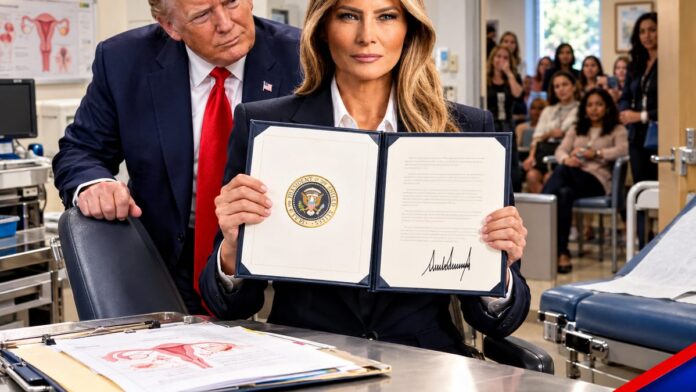
First Lady Melania Trump drove the creation of a new Women’s Health Division at the National Institutes of Health, signing an executive order Monday that targets decades of research neglect in diseases that overwhelmingly affect women.
The division will prioritize endometriosis, osteoporosis, maternal health complications, and heart disease, all conditions where women have faced persistent gaps in treatment and scientific attention.
Melania Trump stated at the signing, “Beginning today, we will change the reality of women’s health.”
The executive order embeds artificial intelligence into the research process, aiming to accelerate the discovery of new treatments without relying on outdated methods that have slowed progress for years.
President Trump credited the First Lady with the idea behind the initiative, describing it during the Rose Garden ceremony as a direct response to shortfalls previous administrations largely ignored.
The division represents a targeted expansion of federal resources into areas where women have suffered measurable harm due to underinvestment.
Endometriosis alone affects roughly 10 percent of women of reproductive age, yet research funding has lagged far behind diseases with smaller patient populations. Maternal health complications remain a leading cause of preventable death during childbirth in the United States, and heart disease kills more women annually than all forms of cancer combined.
Despite these realities, clinical trials and drug development have historically centered on male subjects, leaving treatment protocols poorly suited to female patients.
The new division aims to reverse that pattern by directing NIH resources toward studies specifically designed around women’s physiology and health outcomes.
The integration of AI tools marks a shift in how federal health agencies approach research timelines. By analyzing massive datasets and identifying patterns human researchers might miss, AI can compress the time required to move from hypothesis to clinical trial.
Melania Trump emphasized this technological component during her remarks, framing it as essential to catching up on lost decades of medical progress.
The initiative does not create new funding lines but reallocates existing NIH resources under a dedicated division with a clear mandate. That structure is designed to prevent the scattering of research dollars across unrelated programs, a problem that has plagued women’s health advocacy for years.
The executive order also establishes accountability measures requiring the division to report progress on specific disease outcomes rather than generic research activity.
Conservative health policy experts have pointed to this initiative as evidence that results-driven government action does not require massive spending increases. By focusing resources and embedding modern technology, the administration is delivering measurable change without expanding the federal budget.
The emphasis on maternal health aligns with broader pro-family priorities, addressing a crisis that has seen the United States fall behind other developed nations in preventing childbirth-related deaths.
Critics of previous administrations have noted that women’s health research was often treated as a secondary priority, receiving rhetorical support but little institutional follow-through. This executive order shifts that dynamic by creating a division with dedicated leadership and defined objectives.
The move also reflects Melania Trump’s growing influence on domestic policy, particularly in areas where she has identified gaps between government promises and real-world outcomes. Her public involvement in the signing ceremony underscored her role in shaping the initiative from concept to implementation.
The First Lady has made clear that the division’s success will be measured by tangible improvements in treatment options and survival rates, not by process metrics or research volume. That focus on outcomes over activity represents a departure from the way federal health agencies have traditionally operated.
The executive order positions the Trump administration as willing to challenge institutional inertia when it conflicts with practical results.
Women’s health advocacy groups have responded cautiously, noting that the initiative’s impact will depend on how aggressively the NIH pursues the division’s mandate and whether congressional appropriators maintain funding levels in future budget cycles.
The administration has signaled that it views this as a long-term commitment, not a symbolic gesture. By embedding AI and establishing clear accountability, the order creates a framework designed to survive beyond a single term.
The focus on diseases that disproportionately harm women addresses a moral failure that previous administrations acknowledged but never corrected.
Melania Trump’s leadership on this issue has forced federal health agencies to confront their own track record and commit to measurable change. The executive order signed Monday represents a direct challenge to the status quo, demanding that the NIH treat women’s health as a priority rather than an afterthought.
Sources
- Related posts reviewed for this report:
- Mario Nawfal (@MarioNawfal) on X, Oct 19, 2026
- Fox News (@FoxNews) on X, Oct 19, 2026
- Eric Daugherty (@EricLDaugh) on X, Oct 19, 2026
Posts on X are shown as published by their authors; claims in them are attributed, not independently confirmed unless the article says so. If an embedded post does not load, these links open the originals.