


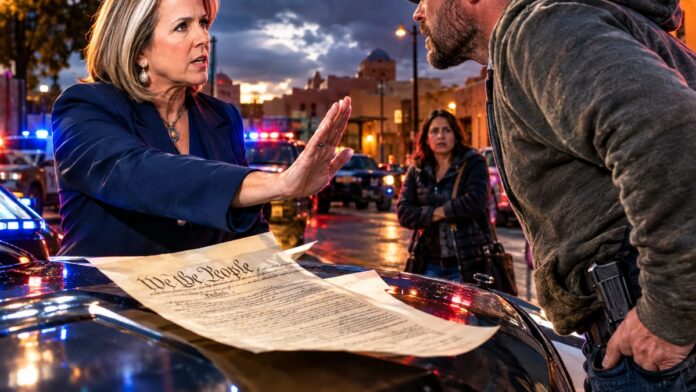
New Mexico Governor Michelle Lujan Grisham Defends Suspending Constitutional Rights During Emergency
New Mexico Governor Michelle Lujan Grisham has publicly defended her authority to suspend constitutional protections, including the Second Amendment, by declaring an emergency and invoking what she describes as temporary additional powers. The Democrat governor’s remarks came during a television interview where she justified restrictions on carry licenses in response to violence in Albuquerque.
Grisham argued that constitutional rights are not absolute and can be limited during crises. She stated that if an emergency exists and she has declared one for a temporary period, she can invoke additional powers. The governor maintained that no constitutional right, including her oath to uphold the Constitution, is intended to be absolute. She compared the restrictions to existing limitations on free speech and other freedoms.
The Governor of New Mexico has just declared the 1st & 2nd Amendment “does not exist” due to an “emergency.”
Under this legal theory *all* of our “rights” are essentially eliminated.
Watch the most evil & tyrannical 60 seconds you’ve ever heard from a politician: pic.twitter.com/UKWlz6GWbz
— John Fitzgerald Kennedy Jr (@realJohnJohnJr) October 5, 2026
The comments directly address the governor’s efforts to tackle violence in Albuquerque, where she referenced an 11-year-old victim and families who have lost children to crime. Grisham insisted that these victims and their families deserve her attention to debate whether emergency measures can create a safer environment. She questioned who is standing up for the constitutional rights of crime victims if she does not act boldly.
The governor framed her emergency declaration as a choice between competing rights. She argued that ignoring the violence problem would signal to other New Mexicans that their rights are subjugated to those who commit crimes. Grisham maintained that the rights of law-abiding citizens suffering from violence are equal to Second Amendment protections and must be balanced through executive action.
When pressed on whether existing laws already criminalize violence, Grisham acknowledged the point but countered by asking who stands up for the right to safety if the climate of violence is out of control. She stated she is doing as much as she knows to do in response to the crisis.
The interviewer challenged whether criminals would actually comply with the temporary carry ban. Grisham conceded that criminals likely would not hear the message and refrain from carrying firearms in Albuquerque for 30 days. However, she insisted the declaration sends what she called a resounding message about her commitment to addressing the violence.
The governor’s legal theory suggests that executive emergency powers can override core Bill of Rights protections on a temporary basis. This approach raises concerns about the precedent for treating fundamental liberties as conditional rather than inherent. The framework allows an executive to unilaterally decide which rights take priority during a crisis and for how long those rights remain suspended.
Conservative critics have long warned against expansive government authority that erodes individual freedoms under the guise of public safety. The New Mexico governor’s remarks align with that concern by explicitly stating that constitutional protections can be set aside when an executive declares an emergency. The logic opens the door to suspending any enumerated right if a governor determines the situation warrants additional powers.
The governor’s position bypasses normal legislative processes and constitutional bounds. By framing the debate as a competition between different sets of rights, Grisham justifies prioritizing some protections over others through unilateral executive action. The approach treats the Second Amendment as negotiable during crises rather than as a fixed limit on government power.
Grisham’s own words reveal the tension in her argument. She took an oath to the Constitution yet claims the authority to suspend constitutional rights when she believes circumstances demand it. The governor acknowledges that her emergency measures will not deter criminals from carrying firearms but maintains the value lies in the message sent by the declaration itself.
The remarks expose the fragility of constitutional protections when executive power expands during emergencies. If a governor can suspend the Second Amendment by declaring a crisis, the same logic applies to the First Amendment, Fourth Amendment, and any other protection in the Bill of Rights. The framework makes fundamental liberties contingent on an executive’s assessment of public safety rather than fixed principles that constrain government action.
New Mexico’s approach sets a dangerous precedent for other states and future administrations. The governor’s defense of emergency powers that override constitutional rights demonstrates how easily protections can be eroded when safety concerns are invoked. The debate over Grisham’s actions will test whether the republic’s foundational limits on government authority hold during times of crisis or whether executives can unilaterally redefine rights based on their interpretation of necessity.
The governor’s admission that her measures will not stop criminals from carrying firearms undermines the justification for suspending constitutional protections. If the policy fails to achieve its stated purpose of enhancing safety, the cost is borne by law-abiding citizens who lose their rights. Grisham’s framework sacrifices enumerated protections for symbolic gestures that acknowledge their own ineffectiveness.
The interview footage circulating online has sparked widespread concern among constitutional advocates and Second Amendment groups. The governor’s explicit claim that she can invoke additional powers during an emergency by setting aside constitutional rights represents a clear statement of executive overreach. The republic’s founding principles demand that rights remain secure even in times of crisis, not that they become optional when an executive deems conditions warrant suspension.
Grisham’s position reflects a broader trend of expanding executive authority at the expense of individual liberty. The willingness to prioritize one set of rights over another through unilateral action erodes the fixed nature of constitutional protections. Americans who value the Bill of Rights as a shield against government power must recognize the threat posed when executives claim the authority to suspend those protections during emergencies they themselves declare.
Sources
- Original post: John Fitzgerald Kennedy Jr (@realJohnJohnJr) on X, Oct 5, 2026
- Related posts reviewed for this report:
- Deep Leaks (@DeepLeaksHQ) on X, Sep 29, 2026
- John Fitzgerald Kennedy Jr. (@MrJohnJr21) on X, Oct 5, 2026
- Benny Johnson (@bennyjohnson) on X, Sep 8, 2023
Posts on X are shown as published by their authors; claims in them are attributed, not independently confirmed unless the article says so. If an embedded post does not load, these links open the originals.