


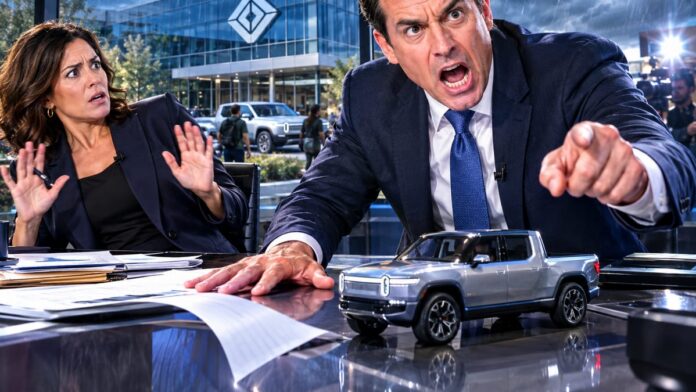
Electric vehicle maker Rivian announced it faces a one hundred million dollar shortfall after the Trump administration rolled back strict federal fuel economy standards put in place by the previous administration.
The company tied the projected loss directly to the relaxation of Corporate Average Fuel Economy rules and tailpipe emission requirements that had created artificial advantages for electric models by imposing steep compliance costs on traditional automakers.
The development exposes how certain manufacturers built their entire business strategy around regulatory pressure rather than genuine consumer demand. Rivian and other recent electric vehicle entrants counted on sustained government intervention to limit competition from internal combustion engines, maintain generous taxpayer-funded purchase subsidies, and enforce aggressive emissions targets that raised the cost of rival gasoline-powered vehicles.
Electric vehicle maker Rivian says it faces a $100 Million hole after Trump relaxed fuel economy rules.
If your business model depends on government mandates instead of actual consumer demand, you don't have a product—you have a subsidy with wheels. pic.twitter.com/xnFFzYYGdo
— Deep Leaks (@DeepLeaksHQ) October 2, 2026
Under the prior framework, those layered mandates functioned as de facto market barriers. Strict CAFE standards and emission rules penalized non-electric offerings, while federal tax credits lowered the effective purchase price for buyers who chose electric models. When those supports are dialed back, companies that treated regulatory tailwinds as permanent features encounter the limits of their original planning.
The conservative position holds that reliance on government coercion reveals a fundamental flaw in the underlying business case. Products that require ongoing federal force to outsell competitors are not true market offerings. They are extensions of policy preferences that shift with elections. Once the rules change and the playing field levels, profitability depends on delivering value that buyers actually want without artificial assistance.
Rivian has produced vehicles praised for performance and design, yet its financial model incorporated assumptions about continued mandates that would sideline gasoline alternatives and preserve subsidy flows. With those assumptions now adjusted by the current administration, the projected one hundred million dollar impact reflects the difference between operating under protected conditions and competing in an open marketplace.
Critics of the prior regulatory regime argue it distorted investment decisions across the entire auto sector by rewarding alignment with policy goals over responsiveness to actual demand. Electric vehicle makers expanded capacity on the expectation that regulators would continue tilting the scale. The Trump administration’s decision to ease those standards restores a measure of neutrality, requiring every participant to succeed on price, features, and reliability rather than on the ability to lobby for favorable rules.
No bailout or additional federal support has been indicated for Rivian or similar firms facing the same headwinds. The episode serves as a clear reminder that businesses built primarily on the prospect of government action to disadvantage competitors remain vulnerable when political conditions change.
Market success ultimately rests on voluntary purchases by consumers who see value in the product itself, not on rules that compel or subsidize them. Companies that cannot adapt to that reality will struggle regardless of how much praise their vehicles receive from reviewers or how many awards they collect at industry events.
The café standards rollback is part of a broader effort by the administration to remove regulatory barriers that increase costs for American families. Federal officials have estimated the new rules will reduce the average price of a new vehicle by thirteen hundred dollars, making car ownership more accessible while allowing manufacturers to respond to what buyers actually want rather than what Washington mandates.
For Rivian, the path forward requires proving its vehicles can compete without the crutch of government intervention. The company must convince buyers that its trucks and SUVs deliver enough value to justify their premium price tags in a market where gasoline-powered alternatives are no longer artificially penalized. That is the test every business faces in a free economy, and no amount of regulatory favoritism can postpone it forever.
Sources
- Original post: Deep Leaks (@DeepLeaksHQ) on X, Oct 2, 2026
- Related posts reviewed for this report:
- AmericanDream-JFk. jr (@Magalife234) on X, Sep 26, 2026
- Rapid Response 47 (@RapidResponse47) on X, Sep 28, 2026
- NewYork-Insight (@NewYork_Insight) on X, Sep 29, 2026
Posts on X are shown as published by their authors; claims in them are attributed, not independently confirmed unless the article says so. If an embedded post does not load, these links open the originals.