


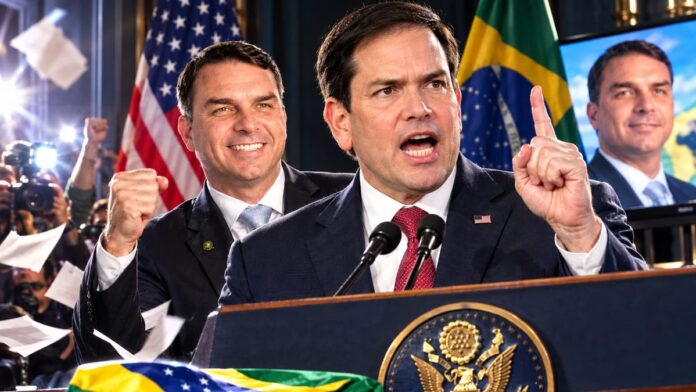
Brazil Runoff Sets Up Hemisphere Realignment as Flavio Bolsonaro Surges Past Lula
Brazil is heading to a presidential runoff after Flavio Bolsonaro, the right-wing son of former president Jair Bolsonaro, captured roughly 47 percent of first-round votes, outpacing leftist incumbent Lula and setting the stage for a decisive October showdown. The result extends a pattern that has reshaped Latin America over the past two years, with voters across the hemisphere rejecting socialist governance in favor of leaders aligned with American interests and pro-growth economic policies.
Marco Rubio highlighted the broader trend during remarks praising the shift. He noted that virtually every election in the Western Hemisphere since the current administration took office has produced a pro-American outcome. For the first time in 15 to 20 years, the overwhelming majority of countries in the region are now led by pro-American leaders and governments, a development Rubio called an extraordinary achievement. The pattern reflects voters responding to tangible results rather than ideology alone, favoring stability, security cooperation, and economic partnerships that benefit the hemisphere.
🚨 WOW! If Brazil FLIPS right-wing after tonight's Flavio Bolsonaro results, Latin America becomes even more DOMINATED by right-leaning or Trump-aligned leaders
And then Cuba? 🔥🔥
BOLSONARO CAN WIN THE RUNOFF! 🇺🇸🇧🇷
MARCO RUBIO CALLED IT: "Virtually EVERY election that's… pic.twitter.com/CJcVjesAii
— Eric Daugherty (@EricLDaugh) October 4, 2026
Venezuela stands as a clear example of the realignment. The country now maintains a cooperative relationship with the United States following political changes that removed adversarial leadership. When a major earthquake struck Venezuela, American forces arrived within 36 hours. The USS Ford docked in port, and Marines assisted at the airport and control tower. Rubio credited multiple agencies, particularly the Department of War, for the swift humanitarian response. The president directed the effort almost immediately, ensuring rapid support that stood out for its speed and effectiveness.
Flavio Bolsonaro’s first-round performance positions him as the favorite heading into the runoff. His campaign focused on economic freedom, law enforcement, and rejection of the corruption that plagued previous leftist governments. Lula’s administration faced mounting criticism over inflation, crime, and ties to discredited socialist policies. Bolsonaro capitalized on voter frustration, running a campaign that mirrored his father’s populist appeal while distancing himself from the elder Bolsonaro’s more controversial rhetoric.
The outcome in Brazil would further isolate holdouts like Cuba and encourage neighboring states to follow the same path. If Bolsonaro wins the October runoff, Brazil joins a growing bloc of right-leaning governments that includes Argentina, Chile, and others that have turned away from the socialist experiments that dominated the region for decades. The shift rewards consistent application of strength and partnership over adversarial posturing.
Cuba remains the most prominent outlier. The island’s communist regime has clung to power despite economic collapse and mass emigration. Rubio and other lawmakers have long argued that Cuba’s turn is inevitable once the hemisphere fully rejects the failed model Havana represents. A Bolsonaro victory in Brazil would intensify pressure on Cuba by demonstrating that voters across the region have definitively rejected the ideology that once promised prosperity but delivered poverty and repression.
The Brazilian runoff takes place October 25. Polls show Bolsonaro maintaining a narrow lead, though the margin remains within typical error rates. Turnout will likely determine the outcome, with both campaigns focused on mobilizing their bases in urban and rural areas. International observers will monitor the vote closely, given the high stakes for regional alignment and the precedent Brazil’s choice could set for future elections.
American policymakers view the trend as validation of diplomatic and economic engagement that prioritizes mutual interests over ideological confrontation. The swift humanitarian response in Venezuela demonstrated how quickly the United States can act when adversarial barriers are removed. That same approach has shaped policy across the hemisphere, with trade agreements, security partnerships, and infrastructure investments replacing the sanctions and isolation that defined earlier eras.
Voting matters. That simple truth underlies the transformation reshaping Latin America. Citizens have rejected leaders who promised equality but delivered corruption, who championed state control but produced shortages, and who spoke of justice while jailing dissidents. The elections reflect a demand for accountability, prosperity, and governments that serve their people rather than foreign ideologies. Brazil’s runoff will test whether that demand continues to reshape the hemisphere or whether the left can reverse the tide.
Sources
- Original post: Eric Daugherty (@EricLDaugh) on X, Oct 4, 2026
- Related posts reviewed for this report:
- Eric Daugherty (@EricLDaugh) on X, Oct 4, 2026
- Benny Johnson (@bennyjohnson) on X, Oct 4, 2026
- Eric Daugherty (@EricLDaugh) on X, Oct 4, 2026
Posts on X are shown as published by their authors; claims in them are attributed, not independently confirmed unless the article says so. If an embedded post does not load, these links open the originals.