


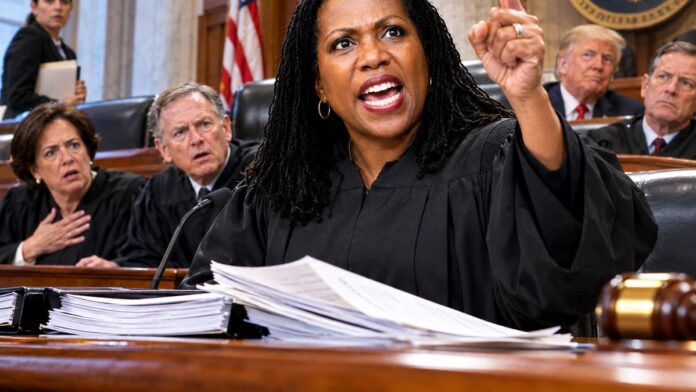
Supreme Court Justice Ketanji Brown Jackson Dissents in SAVE System Ruling — Claims Citizenship Verification Harms Lawful Voters
The Supreme Court ruled six to three to uphold the SAVE system, a Trump administration measure designed to remove noncitizens from voter rolls and ensure only eligible citizens participate in elections. The decision maintains safeguards that enforce existing federal law prohibiting noncitizen voting.
Justice Ketanji Brown Jackson dissented along with the other two Democrat appointees on the court. In her written opinion, Jackson stated that the court focuses on the harms the government will purportedly suffer absent a stay, disregarding the harms that the modified system has caused and will likely continue to cause to lawful voters.
🚨 HOLY CRAP! Supreme Court Justice Ketanji Brown Jackson issued a terrifying dissent of the 6-3 SCOTUS ruling upholding President Trump's anti-noncitizen voter SAVE system — she says it will "HARM" voters
Now how could a system PURELY designed to root out noncitizens and… pic.twitter.com/DyJaXcJBpt
— Eric Daugherty (@EricLDaugh) September 25, 2026
The SAVE system targets verification of citizenship status through cross-checks with federal databases. It does not alter eligibility rules for those already confirmed as citizens. Conservative observers note that claims of harm to lawful voters lack a clear mechanism under the policy. Verification processes are designed to be non-disruptive and rely on existing government records rather than broad administrative overreach.
The ruling aligns with efforts to enforce existing laws that restrict voting to citizens. Noncitizen participation has long been prohibited under federal statutes, and the SAVE framework provides a structured approach to compliance. The conservative majority on the court viewed the system as a straightforward application of those standards.
Jackson’s framing drew immediate criticism for implying that basic eligibility checks equate to voter suppression. Such arguments have surfaced in prior election-related cases but often fail to identify specific groups of eligible voters excluded by accurate record-keeping. The dissent instead centers on potential administrative burdens without detailing how those burdens would disenfranchise citizens who are already verified.
Conservative commentators pointed out that Jackson’s language raises a troubling question: how could a system purely designed to root out noncitizens and illegal aliens harm lawful voters? The logic suggests an acknowledgment that noncitizens have been allowed to vote, and that removing them from the rolls is now being framed as a harm rather than a correction.
The outcome reinforces the priority of accurate voter rolls ahead of future elections. With President Trump in office, the administration has advanced measures to strengthen election integrity. The court’s decision prevents lower-court interventions that could delay those efforts and ensures the system remains in place.
Future appointments to the judiciary remain a key point of contrast between parties. Conservative majorities have consistently supported policies that prioritize citizenship verification over expansive interpretations of access that risk diluting eligible votes. The ruling underscores the importance of maintaining a constitutionalist bench capable of defending the republic’s foundational electoral standards.
The dissent from the three liberal justices signals a broader divide over the role of the courts in election law. Jackson’s opinion reflects a view that eligibility verification itself can be framed as a barrier, a position that conservative legal scholars reject as both legally unfounded and politically motivated.
The SAVE system will continue to operate as designed, ensuring that voter rolls reflect only those legally entitled to participate. The Supreme Court’s decision is a victory for election integrity and a clear signal that the republic’s laws will be enforced regardless of political pressure to the contrary.