


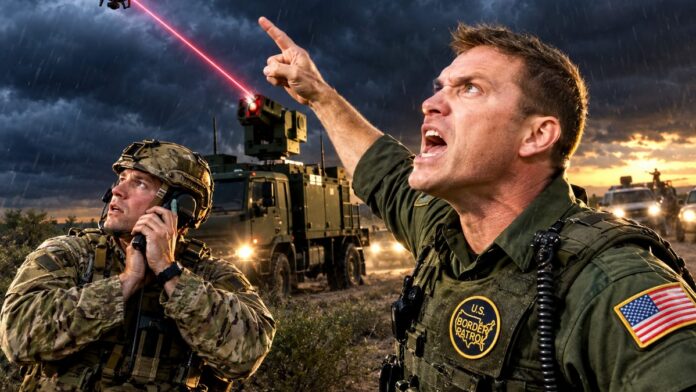
Military Laser System Burns Cartel Drones Over Texas Border — Eleven Destroyed Since August
The U.S. military has deployed truck-mounted laser systems along the southern border and the results are measurable. Joint Task Force Southern Border has used AeroVironment’s LOCUST high-energy laser to destroy eleven cartel-linked drones since late August, all in the Rio Grande Valley. Drone activity in that sector has dropped seventy-five percent during the same period.
The system fires an invisible infrared beam that holds photons on a single point until the drone’s sensors melt or the aircraft breaks apart. The laser mounts on military vehicles, allowing crews to reposition quickly when threats emerge elsewhere along the border. AeroVironment began developing the technology in 2023, and the Army received its first prototypes in September 2025, months before the current deployment.
🇺🇸🇲🇽 The laser burning cartel drones over Texas right now is the same weapon America is counting on against Iran's Shaheds
Joint Task Force Southern Border has taken down eleven cartel drones since late August with truck-mounted LOCUST systems from AeroVironment, and drone… pic.twitter.com/XQUEkLO77N
— Mario Nawfal (@MarioNawfal) September 24, 2026
RGV Sector Border Patrol Chief Jared Ashby confirmed in an exclusive interview that all eleven takedowns occurred in his sector. He stated that agents have observed drones capable of carrying payloads, including one detected in the Rio Grande Valley. Ashby noted the presence of a threat and the deployment of military assets to address it. Border Patrol itself operates signal-based jamming technology, while the military fires the laser.
Cartel operators on the Mexican side use drones to remotely guide groups across the border, reducing the need for smugglers to accompany crossings. The drones provide real-time surveillance and direction, allowing cartels to operate from a distance. Military reports indicate more than three hundred drones defeated along the southern border this year, with over one hundred neutralized in August alone. The seventy-five percent decline in detections followed directly after the laser deployment at the end of August.
The approach highlights a shift toward cost-effective defense. Iranian Shahed drones cost around twenty thousand dollars each to produce. Earlier U.S. efforts against similar threats relied on interceptors priced in the millions, depleting national stockpiles over months of operations. A single laser shot costs three to five dollars when powered by a generator.
The LOCUST system demonstrates the practical application of directed-energy weapons first tested in controlled environments. The mobility of the platform allows it to address both scouting drones and those modified for payload delivery without requiring fixed infrastructure. The reduction in detected activity is evidence that the technology works in operational conditions.
The deployment aligns with priorities for securing the border against evolving aerial tactics employed by cartels. The technology’s low per-shot expense offers a sustainable method for continued operations compared with traditional kinetic interceptors. The system can engage multiple threats without resupply, limited only by available electrical power.
Ashby’s confirmation that payload-capable drones have been detected in the Rio Grande Valley underscores the escalating threat. Cartels are adapting their tactics, moving from simple surveillance to potential delivery by air. The military’s response with high-energy lasers provides a counter that matches the threat’s evolution without the cost spiral of missile-based air defense.
The program predates the current Middle East conflict by months, but the war has validated the economic argument for directed-energy systems. Washington spent seven months swatting Iranian drones with interceptors costing millions each, burning through half the national stockpile. The laser offers a different math: three to five dollars per shot versus millions per missile. That ratio matters when the adversary can produce thousands of cheap drones.
Cartel scouting drones are less sophisticated than military-grade Shaheds, but the lesson applies either way. America is finally learning that the expensive answer is not always the better one. The seventy-five percent drop in drone detections in the Rio Grande Valley since late August is evidence that sometimes the better answer costs less.