


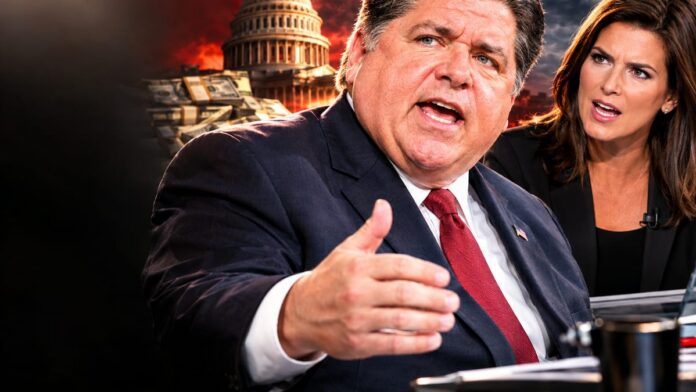
Illinois Governor JB Pritzker faced direct questions on CNN about the growing Democratic chorus attacking billionaires in politics, and his response revealed the awkward position wealthy Democrats occupy within their own party.
When pressed on his own status as one of the wealthiest elected officials in the country, Pritzker deflected the question by pivoting to President Donald Trump instead of addressing the contradiction head-on.
The CNN host framed the issue clearly. Pritzker’s ability to engage in national politics and position himself for a potential 2028 presidential run stems from his substantial personal financial resources. The host then played clips of prominent Democrats attacking billionaires and corporate influence in elections. One clip stated directly: “How does American politics really work? It’s coin-operated. It’s been running on secret money, corporate money, billionaire money, both sides.” Another added: “The billionaires and corporations rigging this economy keep getting richer. The disease is the system that allows big corporations, billionaires, special interests like AIPAC, to buy and sell politicians.”
JB Pritzker has poured HUNDREDS OF MILLIONS of his own fortune into politics.
So when CNN asked him about Dems railing against billionaires, he immediately pivoted to Donald Trump.
Buddy, they’re talking about you. pic.twitter.com/w7lsMX5lO3
— Darren Bailey (@DarrenBaileyIL) September 14, 2026
When asked how he viewed this rhetoric in light of his own background, Pritzker responded by downplaying personal concerns. “I’m not worried about myself,” he said. “What I am worried about is the rigging of the American elections, as well as the rigging of the system against working families.” He pointed to his record as governor, claiming, “I’ve been governor of Illinois for seven and a half years. I’ve been fighting that very rigging. I’ve been standing up for our working families.”
Pritzker quickly shifted focus away from Democratic attacks on wealth and instead targeted President Trump. “What I think we’ve got to do is push back as hard as we can against this attack on democracy that Donald Trump and MAGA Republicans are making,” he said. “And that’s why I’m engaged all over the country, as well as in Illinois, to elect Democrats, because we have to change the direction of this country. We have to make sure that Donald Trump doesn’t have the ability to continue to attack our working families and to continue to take us into wars that he can’t win and that are costing the American people.”
The exchange underscored a pattern among some Democratic figures who rail against billionaire involvement in politics while themselves relying on personal fortunes to advance their agendas. Pritzker has poured hundreds of millions of dollars of his own fortune into political efforts over the years. His pivot to blaming the sitting president rather than addressing the direct question about anti-billionaire sentiment from his own party drew attention for its avoidance of the core issue raised by the host.
Observers noted that the criticism of wealth in Democratic circles often spares those within the party who have spent heavily from their own resources to shape elections and policy. Pritzker’s responses avoided defending his own financial position and instead framed the debate around opposition to the current administration.
This approach reflects broader tensions within Democratic messaging, where attacks on billionaires coexist with support from wealthy donors and candidates who use personal wealth to fund campaigns and political operations. The CNN interview highlighted the discomfort that arises when that contradiction is brought into the open and a direct answer is demanded.
Pritzker’s deflection strategy is not new. The Illinois governor has consistently positioned himself as a champion of working families while leveraging his own considerable wealth to influence political outcomes. The tension between rhetoric and reality becomes unavoidable when the subject is put on the spot by a national media outlet willing to ask the question directly.
The interview serves as a reminder that the Democratic Party’s relationship with wealth and influence is more complicated than its public messaging often suggests. When billionaires are Democrats, the criticism tends to be muted or redirected. When they are not, they become the target of sustained attack. Pritzker’s response to the CNN host made that double standard plain for anyone paying attention.