

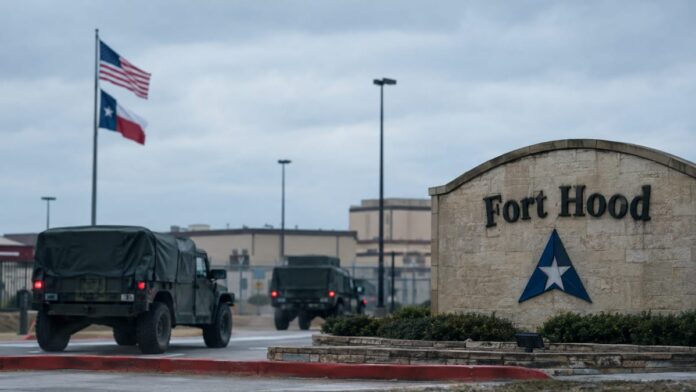
Federal prosecutors asked a judge in Kansas on Nov. 27 to deny Nidal Hasan’s request to postpone his Dec. 3 execution by firing squad, a motion the Fort Hood gunman filed nine days before his scheduled execution.
Hasan has not yet filed the habeas petition he wants time to bring. In its 25-page response, the U.S. Attorney’s Office for the District of Kansas calls the claims he plans to raise untimely and meritless. U.S. District Judge Anthony W. Mattivi has set a public hearing for Monday, Nov. 30.
What the government’s filing says
Hasan, a former Army major, was convicted by a general court-martial on 13 specifications of premeditated murder and 32 of attempted premeditated murder for the Nov. 5, 2009, attack at the Soldier Readiness Processing center at Fort Hood, Texas. The Army Court of Criminal Appeals and the Court of Appeals for the Armed Forces affirmed, and the Supreme Court denied review on March 31, 2025. He sought no post-conviction relief after that until his Nov. 24 motion.
Hasan has signaled two claims. The first is that he acted in “defense of others” because the soldiers he shot posed a threat to the Taliban. The second is that the president and the defense secretary engaged in “unlawful command influence” in approving and scheduling his execution. The government’s answer: the military courts already rejected the first claim, which is frivolous, and the second is not a proper subject for habeas review and is barred by laches after seven weeks of delay.
The response is blunt about the self-defense theory. Under Hasan’s reasoning, it argues, anyone could decide on his own that a war was unlawful and gun down U.S. troops before they ever reached a battlefield. “The government respectfully moves this Court to reject the defendant’s arguments and deny his motion seeking to stay his execution,” the filing concludes.
Why it matters
President Trump approved the death sentence on Oct. 2. On Oct. 6, Acting Army Secretary Adam R. Telle ordered the commandant of the U.S. Disciplinary Barracks to carry it out at 1 p.m. on Dec. 3 at Fort Hood. If it goes forward, it will be the U.S. military’s first execution since 1961 and its first by firing squad since World War II. Trump earlier canceled plans announced by Defense Secretary Pete Hegseth to livestream the execution.
Daily Beltway analysis: the fight Monday is narrow. Prosecutors are not relitigating the 2013 verdict; they argue that a promise to file a petition someday is not enough to freeze a sentence the military courts affirmed and the Supreme Court declined to review. The government also points to the victims of the attack, many of whom, per the filing, are about to travel to Texas to witness the execution.
Hasan’s case
In his Nov. 24 motion, Hasan wrote that he “intends to demonstrate that the military court’s judgment and his resulting sentence of death were obtained and are maintained in violation of his federal constitutional and statutory rights.” He also alleges that Trump and Hegseth were motivated by racial and religious bias to interfere in his case. Hasan is Muslim and an Arab American of Palestinian descent.
The ACLU of Kansas is serving as standby counsel. “There is no question that the violence committed at Fort Hood caused unimaginable pain and loss. But the gravity of that loss does not change the government’s obligation to uphold the principles that define our justice system,” Anna Arceneaux, deputy director of the ACLU’s Capital Punishment Project, said in a statement.
What’s next
Hasan may reply by noon Central time on Saturday, Nov. 28. Mattivi will hear arguments at 10 a.m. Central on Monday, Nov. 30, at the Robert J. Dole U.S. Courthouse in Kansas City, Kansas, and has ordered the government to bring Hasan in person from Fort Leavenworth. The execution remains set for 1 p.m. on Thursday, Dec. 3.