


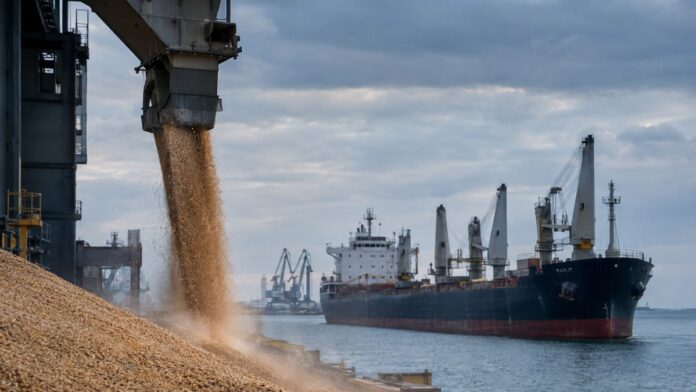
Ukraine has put a Black Sea ceasefire offer before Russia that would restore freedom of navigation and reopen the sea to its grain and other farm exports. Foreign Minister Andrii Sybiha made the offer public Nov. 27 in Kyiv at the 5th Food from Ukraine conference, a food-security summit opened by President Volodymyr Zelenskyy.
“We are now awaiting a response from Russia. All our proposals have been submitted,” Sybiha told reporters, according to Ukrinform. On Moscow’s push to add oil, he said: “Oil could be part of a broader energy truce. But as regards the Black Sea, we are focusing on agricultural products.” He thanked India, Turkey and Egypt for their mediation and accused Russia of answering each Ukrainian package with “unrealistic demands.”
Opened the 5th Food from Ukraine Summit.
Food must never be used as a weapon. Yet Russia attacks any vessel that tries to carry our food exports. Over 30 million tons are at risk, enough to feed more than 100 million people for a year. From West Africa to South Asia, millions of… pic.twitter.com/cfHDukwzWf
— Andrii Sybiha 🇺🇦 (@andrii_sybiha) November 27, 2026
What Kyiv is proposing
The offer is narrow by design: a truce covering shipping and agricultural products only. Moscow wants more. Russia has proposed that Ukraine halt attacks on Russia’s oil sector as part of the truce, and Kyiv will consider that only inside a broader energy ceasefire that covers all energy components.
“Over 30 million tons are at risk, enough to feed more than 100 million people for a year,” Sybiha wrote on X. The Agrarian Policy Ministry estimates that alternative land, river and rail routes now handle only 45% to 50% of the farm exports Ukraine needs to move. If sea restrictions last until summer 2027, grain stocks inside Ukraine could reach 30 million tonnes, and up to 6 million hectares could go unsown by spring 2027. Sybiha warned that Russia must not turn the Black Sea into “a sort of Strait of Hormuz,” while more than 40% of Russia’s own exports move through the Baltic Sea.
Why it matters
The corridor has been shut before. A UN- and Turkey-brokered deal reopened Ukrainian grain exports after Russia’s 2022 invasion, and Moscow pulled out of it in July 2023, forcing Ukraine to set up an alternative maritime route.
The squeeze shows up in Ukraine’s food aid. Since 2022, the Food from Ukraine program has drawn more than $395 million in announced contributions and bought over 343,000 tonnes of food for 20 countries. The United States is among its largest donors by volume, at 26,500 tonnes. This year, deliveries have fallen to about 16,500 tonnes.
Washington has shown interest in a limited deal. Secretary of State Marco Rubio said Oct. 31 that the U.S. was examining proposals forwarded by Turkey to restore grain shipments. “It doesn’t solve the war, but at least it solves a unique aspect of it,” he said. Daily Beltway analysis: a food-only truce lets Kyiv test Moscow on a single issue that partners like India and Egypt care about, without waiting for a full peace settlement.
Moscow’s position
The Kremlin has already signaled resistance to the idea. On Nov. 26, spokesman Dmitry Peskov rejected European Commission President Ursula von der Leyen’s call for Russia to accept a winter halt to energy strikes and a ceasefire for safe food exports through the Black Sea. “Russia is under no obligation to do anything. Russia must safeguard its national interests,” Peskov told the Russian outlet Vesti, according to Ukrainska Pravda. He added that “with such ultimatums, it is very difficult to aspire to the role of mediator or participant in settlement negotiations.”
What’s next
Ukraine’s government aims to announce a business war-risk insurance fund with international partners at the Ukraine Recovery Conference in Tallinn, Estonia, on Jan. 28-29, 2027. The target is up to $3 billion or 3 billion euros in starting capital.
On the farm side, the next marker is spring 2027 planting, when unsold grain could leave millions of hectares empty.
Sources
- minagro.gov.ua
- minagro.gov.ua
- urc27.org
- ukrinform.net
- rferl.org
- en.interfax.com.ua
- en.interfax.com.ua
- en.interfax.com.ua
- aa.com.tr
- pravda.com.ua
- Original post: Andrii Sybiha 🇺🇦 (@andrii_sybiha) on X, Nov 27, 2026
Posts on X are shown as published by their authors; claims in them are attributed, not independently confirmed unless the article says so. If an embedded post does not load, these links open the originals.