


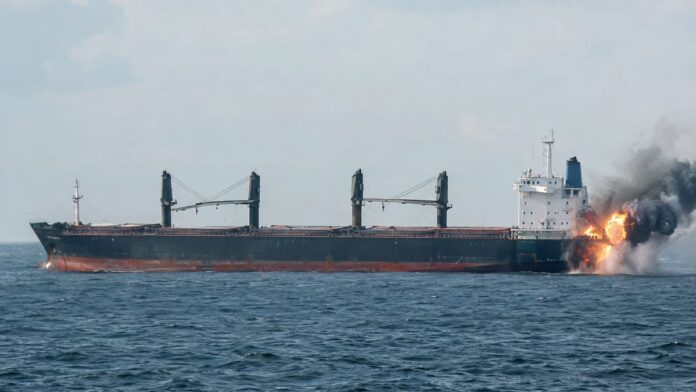
U.S. Central Command disabled a Palau-flagged bulk carrier in the Gulf of Oman on Thanksgiving Day after its crew tried to run the American naval blockade of Iran despite multiple warnings. A U.S. military aircraft fired precision munitions into the stern of the M/V Pacific Archer on Nov. 26, knocking out its propulsion. The civilian crew was unharmed.
The ship had departed the southern Iranian port of Bandar Abbas. It is the sixth merchant vessel U.S. forces have disabled for refusing to comply with the blockade. CENTCOM released video of the strike Friday.
CENTCOM disabled a commercial vessel in the Gulf of Oman, Nov. 26, after the crew attempted to run the U.S. naval blockade, despite multiple warnings, following departure from Bandar Abbas.
A U.S. military aircraft launched precision munitions that struck the stern of… pic.twitter.com/uD2orCew6b
— U.S. Central Command (@CENTCOM) November 27, 2026
What CENTCOM’s release lays out
The bulk carrier tried to transit regional waters after leaving Bandar Abbas and ignored repeated warnings before the aircraft struck. The release gives no details on the cargo, the number of crew aboard or the type of aircraft involved.
U.S. forces have now redirected 158 compliant commercial vessels and disabled six that refused. CENTCOM is urging all mariners in the Gulf of Oman and the approaches to the Strait of Hormuz to heed blockade warnings.
The ship’s classification record with ClassNK, the Japanese classification society, lists the Pacific Archer as a 52,407-deadweight-ton bulk carrier launched in 2001, registered in Palau to Pacific A Shipping Limited and managed by Optimo Marine Limited. It previously sailed as the Thor Independence and the Yasa H. Mehmet.
By the numbers
- 158: commercial vessels redirected under the blockade, up from 147 on Nov. 7
- 6: merchant ships disabled for refusing to comply, up from five
- 19 days: time since the last reported disabling, the St. Kitts-flagged M/V Huda on Nov. 7
Why it matters
The count rose from five to six, making this the first disabling CENTCOM has reported since the Huda, which was also hit in the stern by a U.S. aircraft after visiting an Iranian port. CENTCOM’s Nov. 7 release put the totals at 147 ships redirected and five disabled since July. U.S. forces had earlier destroyed 10 commercial tankers tied to Iran’s oil trade.
Daily Beltway analysis: by CENTCOM’s own count, about 96% of the ships that met the blockade line turned back without a shot. The strikes CENTCOM has disclosed hit ships’ sterns, and in this case no crew member was hurt.
The strike came the same day President Trump took questions from reporters at Mar-a-Lago, where he said he is giving Iran “a chance to be smart.” “We’re giving them every chance to make a deal and save a lot of lives, but I’m not sure if they are going to take advantage of that,” he said, CBS News reported.
What Tehran says
Iranian officials had not commented on the Pacific Archer specifically, Anadolu Agency reported. But Majid Mousavi, commander of the Islamic Revolutionary Guard Corps’ Aerospace Force, warned in a post on X that Iran’s enemies should expect military action in the air and at sea, and called breaking the U.S. blockade Iran’s “firm mission and unwavering determination,” Ynet News reported.
Separately, Iran’s navy commander, Rear Adm. Shahram Irani, claimed Friday that commandos had retaken two Iranian tankers seized by U.S. forces. He offered no evidence, and CENTCOM did not immediately respond to the claim, according to CBS News, which noted the U.S. military has not announced seizing an Iranian or Iran-linked commercial vessel since April.
What’s next
The blockade warning to mariners stands with no end date. Trump has pointed to the new year as the window for Iran to agree to a peace deal, according to CBS News.
Sources
- centcom.mil
- dvidshub.net
- classnk.or.jp
- maritime-executive.com
- stripes.com
- aa.com.tr
- ynetnews.com
- cbsnews.com
- Original post: U.S. Central Command (@CENTCOM) on X, Nov 27, 2026
If an embedded post does not load, these links open the originals.