


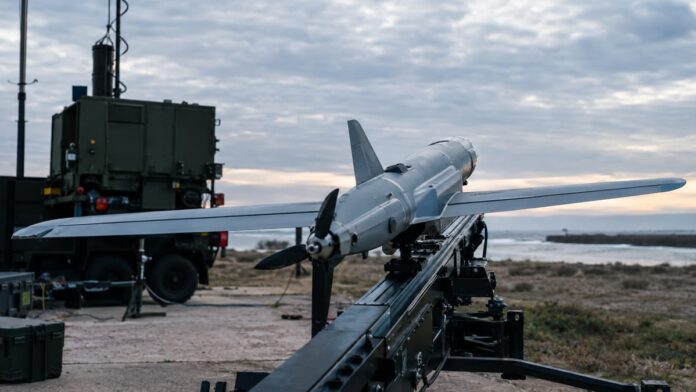
The Pentagon’s Defense Innovation Unit has opened a prize challenge for low-cost, surface-launched strike drones that can fly hundreds of miles and keep working when GPS and communications are jammed. The solicitation, called Drone Dominance: Extended Range Strike Gauntlet II, was announced Nov. 25 and budgets up to $500 million for prizes and follow-on work.
Proposals are due Dec. 7 at 11:59 p.m. Eastern. The government wants systems ready for a U.S. demonstration by mid-March 2027, 20 to 30 delivered by June 2027 for end-user validation, and more than 100 delivered within six to eight months of the solicitation.
Our Drone Dominance: Extended Range Strike – Gauntlet II solicitation is live.
We’re partnering with DRPM-UxS to field affordable, surface-launched strike drones at scale, at range, and built to win in jammed, contested, and disconnected environments.
We want low-cost systems… pic.twitter.com/LBbgyoGUkf
— Department of War Innovation Unit (@DIU_x) November 25, 2026
What the solicitation asks for
The challenge has two tiers. Long-range entries must fly 600 or more nautical miles, carry at least 25 pounds with more than 100 pounds strongly preferred, and come in under $250,000 all-up flyaway cost at scale. Medium-range entries cover 20 to 600 nautical miles with a 7-pound minimum payload and a flyaway cost under $130,000 at scale.
The main yardstick is cost per effect: the fully burdened unit cost, including launchers, ground control stations and software licenses, divided by the mission success rate. The target is under $500,000 for long range and under $300,000 for medium range. Bidders also need a credible path to build 100 or more systems a month within six months, automatic target recognition and navigation that works without satellite signals.
Every company that attempts all of the “test cards” at the March event gets a $500,000 cash prize. Top performers can win prototype Other Transaction Agreements and, after favorable end-user evaluations, larger prototype and production awards. The challenge is open to U.S. and international companies. Firms that won prototype deals in Gauntlet I, formerly the Ground-Based Affordable Mass challenge, are invited straight in.
Why it matters
The solicitation spells out the problem in plain terms: “high costs and long production times make it impossible to use them at scale, and adversaries are increasingly disrupting our communications and GPS.” Daily Beltway analysis: this is a bet on cheap mass over a handful of expensive missiles.
The timing tracks a Nov. 19 Government Accountability Office report to the House Armed Services Committee. GAO found the department “does not have an overarching plan that links munitions production and funding to requirements,” and that a Munitions Acceleration Council set up in July 2025 still had no formal signed charter as of November 2026. GAO said a plan could guide how the department spends at least $25 billion Congress appropriated in 2025 for munitions. The department generally concurred with its four recommendations.
The debate over what fixes the shortfall
Michael Horowitz of the Council on Foreign Relations backs the approach. “The single most important thing the Pentagon needs to do is continue ramping investments in precise mass systems like inexpensive cruise missiles and long-range, one-way attack drones,” he told Fortune.
Michael O’Hanlon of the Brookings Institution puts the bottleneck elsewhere. “The issue is less the absence of a single formal plan on paper and much more physical constraints limiting capacity,” he said. “A better plan might help, but it’s not the core issue or driver.”
What’s next
- Dec. 7, 2026: Solution briefs due by 11:59 p.m. Eastern.
- December 2026: DIU plans to release an Extended Range Strike supply chain framework; compliance is required for award.
- Mid-March 2027: Gauntlet II demonstration at a government-selected test site. Each invited company brings three inert systems and no more than eight people.
- April 2027: Gauntlet III solicitation expected, with that round starting in mid-August 2027.
Sources
- diu.mil
- dmi-ida.org
- defensedaily.com
- soldiersystems.net
- dronenr.com
- fortune.com
- Original post: Department of War Innovation Unit (@DIU_x) on X, Nov 25, 2026
If an embedded post does not load, these links open the originals.