


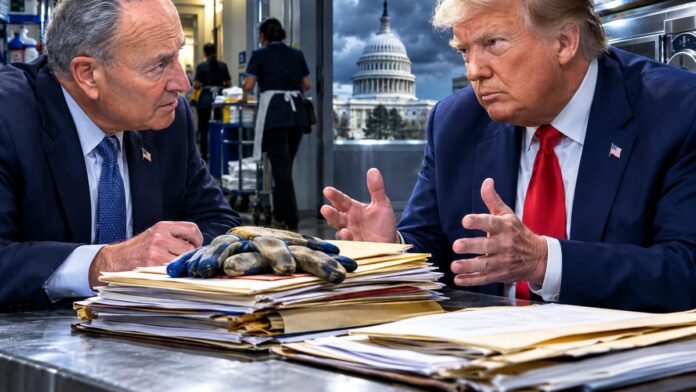
President Trump has signaled willingness to negotiate an immigration compromise with Democrats that could grant legal status to millions of people who entered the country illegally, marking a sharp departure from the mass deportation mandate voters gave him in 2024.
In a recent interview, Trump acknowledged his administration’s deportation policies may have been too aggressive and suggested he is open to working out a deal that would allow certain categories of undocumented immigrants to remain in the United States legally. When asked directly whether his deportation approach went too far, Trump responded: “I think it might be too tough, yeah.”
The President’s comments represent a major policy shift. Trump campaigned on a hardline immigration platform that promised strict enforcement and removal of individuals who entered illegally. He won a decisive electoral victory in 2024 with immigration enforcement as a centerpiece issue, and enforcement is the promise his base voted for.
🚨NEWS: President Trump has said he is willing to do a deal on immigration possibly granting AMNESTY to millions of illegals
Trump promised no wars and mass deportations
Looks like he is going to fail on both
Disaster pic.twitter.com/CmHkjXcR4c
— Basil the Great (@BasilTheGreat) November 9, 2026
Trump outlined a framework that would distinguish between categories of undocumented immigrants based on criminal history and employment status. He suggested that individuals with long work histories in industries like hospitality, landscaping, and service sectors could be candidates for legal status arrangements.
“I get very high marks for getting the bad ones out,” Trump said in the interview. “But I get hurt because we also took people that had good jobs, that created one violation or breaking of the law, and that was that they came into the country illegally.”
Trump described the political calculation behind his evolving position, acknowledging that removing employed workers who had been in the country for years created negative optics. “When you go into a hotel and you have a woman that’s worked there as a maid, as a cleaner, as a this, as a that, as a waitress, a lot of good things, great jobs. And all of a sudden, they’re being taken out of the country. It’s tough,” he explained.
When pressed on whether such an arrangement could create legal status for workers like hotel employees and landscapers, Trump indicated the possibility was “doable.” He suggested working out terms with the Democratic Party on the matter, framing it as a negotiable issue rather than a fixed enforcement principle.
Trump’s proposal amounts to amnesty by another name. Legal status for individuals who entered illegally rewards lawbreaking and creates a incentive for future illegal immigration. The 1986 Immigration Reform and Control Act granted amnesty to roughly 2.7 million illegal immigrants under the promise that border security would be strengthened and future illegal immigration prevented. Instead, illegal immigration accelerated in the following decades.
The President positioned his emerging stance as a middle ground between complete deportation and blanket amnesty. “Get the killers out. Get all the rough ones out. Get the drug dealers out. But let the people that are here, and, in some cases, here for 10 and 15 years, work a deal for them,” Trump said.
Trump acknowledged divisions within his coalition on the issue, describing a spectrum of viewpoints ranging from those seeking complete deportation to those favoring selective enforcement focused only on removing violent criminals. He characterized immigration restrictionists as being on the “pretty far right,” distancing himself from the enforcement-first position that animated his electoral base.
The law is the law. Illegal entry is a federal crime. Equal enforcement means removing individuals who violated immigration law regardless of how long they have been here or whether they secured employment. A legal status compromise creates two tiers of justice: one for citizens who must follow the rules, and one for foreign nationals who broke them.
Trump’s acknowledgment that deportation policy “hurt” him politically suggests electoral calculations influenced his reconsideration. But a tough midterm is no reason to abandon the voters who put him in office. They did not send him to Washington to cut a legal-status deal with Democrats.
The proposed deal would effectively create a pathway to legal status for a substantial population of undocumented immigrants currently residing in the country. The exact number is uncertain, but estimates of the total illegal immigrant population range from 11 million to over 20 million individuals. Any deal that carves out exceptions for employment or length of residence would likely cover millions.
Trump’s willingness to negotiate represents a significant departure from the mandate voters gave him. Conservatives elected Donald Trump to enforce the law, secure the border, and remove individuals who entered illegally. Working out a deal with Democrats that creates legal status for illegal immigrants is precisely the kind of Washington compromise that Trump campaigned against.
The proposal also raises serious national security concerns. The Biden administration allowed millions of individuals to enter the country without proper vetting. Border agents logged hundreds of encounters with people on the terrorist watchlist in those years, and the cartels running people and fentanyl across that border are now designated foreign t*rrorist organizations. Any amnesty framework must account for the reality that thorough background checks and security screening are impossible for individuals who entered outside legal channels and have been living in the country under false or borrowed identities.
Whether such a deal proves viable with a Democratic legislative partner remains unclear. Democrats may demand broader amnesty provisions than Trump is willing to accept. Immigration restrictionists within the Republican base are likely to oppose any compromise that rewards illegal entry with legal status.
Trump himself says he earned “an A-plus for closing up the border” and high marks for “getting the bad ones out.” By his own account, the enforcement mission is working. There is no policy rationale for abandoning it now in favor of a negotiated amnesty.
The President built his political career on the promise that he would enforce immigration law without exception. Voters trusted that promise and gave him the White House. A deal that grants legal status to millions who entered illegally breaks that trust and sets a dangerous precedent for future administrations.
Sources
- Original post: Basil the Great (@BasilTheGreat) on X
- Related posts reviewed for this report:
- Eric Daugherty (@EricLDaugh) on X, Nov 8, 2026
- AF Post (@AFpost) on X, Nov 8, 2026
- RedWave Press (@RedWavePress) on X, Nov 8, 2026
Posts on X are shown as published by their authors; claims in them are attributed, not independently confirmed unless the article says so. If an embedded post does not load, these links open the originals.