

Five States Lock In Voter ID and Citizenship Requirements Despite Republican Midterm Losses
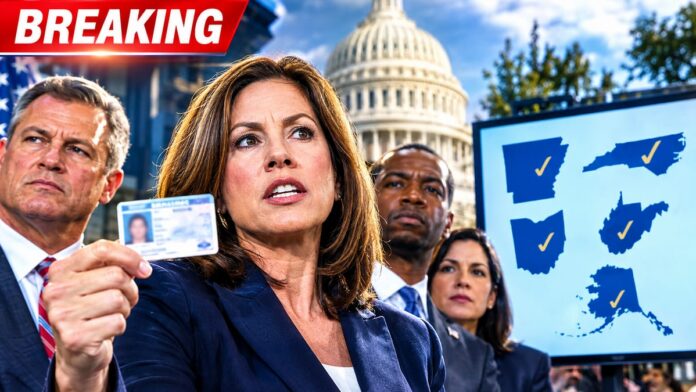
Voters in five states approved election integrity measures on Election Day, locking in voter identification requirements and citizenship verification standards even as Republicans faced significant defeats in the broader midterm environment.
The measures passed decisively in Arkansas, North Carolina, Ohio, West Virginia and Alaska, crossing regional and political divides to strengthen voting eligibility standards across a geographically diverse set of states.
Several states GREENLIT voter ID and election integrity measures in landslides — DESPITE a HORRIFIC night for Republicans — including Arkansas, North Carolina, West Virginia, Ohio, and Alaska.
Fox News’ Alex Hogan: “In Arkansas, only U.S. citizens who show a form of photo ID and… pic.twitter.com/Q0VsFN4jsC
— RedWave Press (@RedWavePress) November 4, 2026
Arkansas voters approved a requirement that only U.S. citizens who present a form of photo identification and are at least 18 years old can vote in elections. The measure ties participation rights explicitly to citizenship status and age requirements, adding a straightforward verification layer to the state’s voting process.
North Carolina implemented a more targeted approach, requiring photo identification specifically for mail-in ballots. The measure addresses concerns about the integrity of absentee voting, which has expanded significantly in recent election cycles, by ensuring that remote voters provide the same identity verification that in-person voters do at polling places.
Ohio took a particularly significant step by embedding voter ID requirements directly into the state constitution. This approach creates a structural barrier to future repeal efforts. Rather than relying on statutory law that can be changed by subsequent legislatures or court rulings, Ohio voters chose to constitutionalize the requirement, making it substantially harder for state government to reverse the policy without another constitutional amendment approved by voters.
West Virginia clarified its election code by explicitly specifying that only U.S. citizens are allowed to vote in elections. While citizenship has long been a legal requirement for voting, the state’s explicit codification addresses ambiguities in existing language and reinforces the foundational principle that voting is a right reserved for citizens.
Alaska voters approved measures reinforcing existing voting criteria. Under the approved measures, voters must be citizens and meet additional requirements to participate in elections, including being at least 18 years old on Election Day and having registered to vote at least 30 days before the election. These standards align with the voting requirements in many states and establish clear eligibility benchmarks.
The victories on election integrity stand out as bright spots in what proved to be a difficult night for Republican candidates across many races. Democrats won control of the U.S. House early Wednesday, completing a sweep of both chambers of Congress and setting up two years of divided government in which President Donald Trump will face a Democratic Congress. The AP called the House at 1:26 a.m. Eastern time Wednesday.
Yet while the GOP faced significant challenges in the broader electoral environment, voters in these five states clearly signaled support for stronger voting standards and citizenship verification measures. The pattern suggests that election security remains a priority for voters independent of their views on other political questions.
The measures passed without partisan framing dominating the debate, instead presenting themselves as straightforward reforms addressing voter eligibility and ballot integrity. Election integrity advocates have emphasized that voter ID requirements and citizenship verification serve important functions in maintaining public confidence in the voting process.
The constitutional amendment approach taken by Ohio is particularly noteworthy from a structural perspective. By requiring voter approval to change the ID requirement, Ohio voters created a durable policy that insulates voting procedures from shifts in legislative control or judicial intervention based on evolving interpretations of law.
These five states represent a constituency of voters genuinely concerned about the integrity and credibility of elections, even in an election cycle dominated by other issues and challenging political dynamics for conservatives. The approval of these measures follows a pattern seen in other states, where ballot initiatives addressing voting procedures have often received strong support regardless of the broader political environment.
The measures take effect according to each state’s implementation schedule, with election officials in each state now responsible for enforcing the new requirements in future elections.
Sources
- Original post: RedWave Press (@RedWavePress) on X, Nov 4, 2026
- Related posts reviewed for this report:
- charlie ward (@charliewwg1wga) on X, Nov 4, 2026
- John F.Kennedy Jr (@real_jfkjr01) on X, Nov 4, 2026
- Natalie Harp Truth Social Post On X (@NatalieHarpQ) on X, Nov 4, 2026
Posts on X are shown as published by their authors; claims in them are attributed, not independently confirmed unless the article says so. If an embedded post does not load, these links open the originals.