

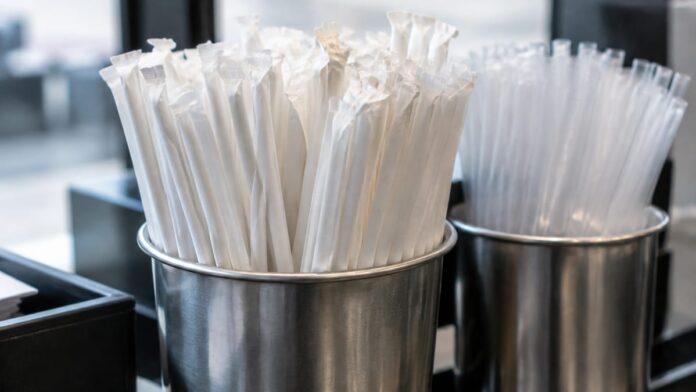
Paper straws, sold for years as the responsible alternative to plastic, carry a heavier environmental burden than the plastic straws they replaced in most of the categories measured, according to a government-commissioned study in South Korea.
The report, titled “Comprehensive Survey on Single-Use Straws,” was commissioned by South Korea’s Ministry of Climate, Energy and Environment and disclosed on Oct. 22 by Rep. Kim Wi-sang of the People Power Party, according to The Korea Herald and the Seoul Economic Daily. Researchers compared four kinds of straws from May of last year through April of this year: conventional polypropylene plastic, paper, biodegradable plastic and bio-based polyethylene, the Seoul Economic Daily reported.
A new study from South Korea found that paper straws are somehow worse for the environment than single-use plastic straws.
None of the "eco-friendly" solutions actually worked, and switching away from plastic straws didn't really help the environment. pic.twitter.com/aJYnZEWRuT
— Pubity (@pubity) October 25, 2026
The study scored each straw across 16 categories covering the full life cycle, from raw material production to disposal, including greenhouse gas emissions, ozone depletion, acidification, particulate matter and human carcinogenic effects, according to SBS News.
Plastic came out on top
Conventional plastic straws had the lowest environmental impact in 10 of the 16 categories, including climate change, acidification, particulate matter and human toxicity, The Korea Herald reported. According to SBS News, plastic straws ranked worst in only one category, fossil resource depletion.
Paper straws scored 6.33 times higher than plastic on the study’s measure of human carcinogenic impact and 2.04 times higher on acidification, according to The Korea Herald. The Seoul Economic Daily reported that paper straws also scored 2.23 times higher on ozone depletion and 1.62 times higher on particulate matter.
The Korea Herald noted that the carcinogenic figure is a modeled life-cycle measure, not a direct measure of cancer risk to people who use the straws.
The so-called green plastics did even worse. Bio-based polyethylene straws scored 16.18 times higher than conventional plastic on the carcinogenic measure and had the largest impact of any straw in 10 categories, according to SBS News. Biodegradable plastic straws scored 3.34 times higher on the carcinogenic measure, The Korea Herald reported.
Recycling did not rescue them
The researchers also found that straws of every material are hard to recycle in practice. Sorting facilities treated straws as non-recyclable waste and burned them because they are too small for machines and workers to separate, according to the Seoul Economic Daily. Coatings and adhesives on some products made recycling even harder, the outlet reported.
The researchers concluded that banning only conventional plastic straws while allowing paper and biodegradable ones “is not appropriate,” according to the Seoul Economic Daily. They instead recommended that stores stop offering any disposable straw by default and hand one out only when a customer asks.
A survey of 1,001 people included in the report found that 87.5 percent preferred plastic straws, The Korea Herald reported.
“It is time to stop meaningless regulations that merely change materials,” Kim said, according to SBS News.
Why it matters here
The findings land in a debate Americans know well. In February 2025, President Trump signed an executive order titled “Ending Procurement and Forced Use of Paper Straws,” according to the White House, directing the federal government to stop buying paper straws. Critics mocked the order at the time as a culture-war sideshow.
The South Korean study does not settle every question, and its researchers said the better answer is using fewer disposable straws of any kind, according to the Seoul Economic Daily. But it undercuts the core claim behind years of paper-straw mandates: that switching materials was helping the planet. By the study’s own measures, in most categories it was not.
Sources
- The Korea Herald
- Seoul Economic Daily
- SBS News
- The White House: Ending Procurement and Forced Use of Paper Straws
- Pubity on X
Sources cited
- https://www.koreaherald.com/article/10911494
- https://en.sedaily.com/society/2026/10/22/paper-straws-carry-up-to-16-times-higher-cancer-impact
- https://news.sbs.co.kr/english/article.do?news_id=N1008808409
- https://www.whitehouse.gov/presidential-actions/2025/02/ending-procurement-and-forced-use-of-paper-straws/
Sources
- Original post: Pubity (@pubity) on X, Oct 25, 2026
Posts on X are shown as published by their authors; claims in them are attributed, not independently confirmed unless the article says so. If an embedded post does not load, these links open the originals.