
JB Pritzker Named in Secret Memo to Governors on Plan to Declare Federal Government Illegitimate
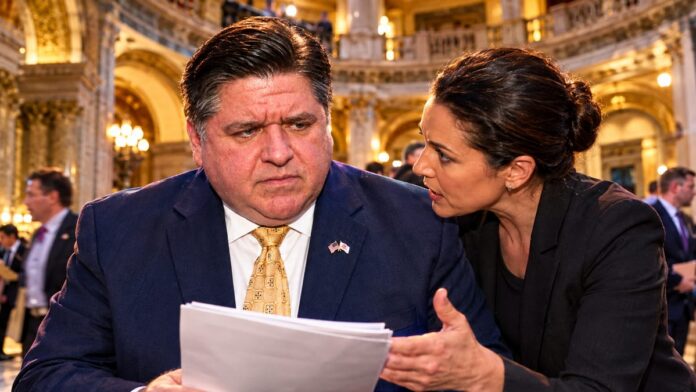
Activists captured on tape have detailed a coordinated plan to empower state governors to assume control of federal functions if they declare the national government illegitimate, and Illinois Governor J.B. Pritzker is explicitly named as one of two governors who expressed interest in the scheme.
The leaked recording reveals that a memo was prepared specifically for governors, outlining steps to wall off federal actors they deem illegitimate and coordinate among states to run portions of the country without a functioning federal structure. The speaker on the tape confirmed the memo was delivered to the governors of Massachusetts, California, and Illinois. Massachusetts refused to engage. California and Illinois both indicated they were willing to participate if another state took the lead.
Activists on tape say they got Illinois a plan for governors to "run the country" if they declare the federal government "illegitimate," and that Illinois was "interested." @JBPritzker, did your office get this memo?
What did you tell them? pic.twitter.com/DBKVfOMtWY
— Darren Bailey (@DarrenBaileyIL) October 23, 2026
The plan hinges on a legitimacy crisis that activists believe could unfold in the next few months or years. The recording describes this moment as an opportunity to leverage a breakdown in federal authority for what the speaker called a refounding moment and structural reform. The memo was designed to guide governors through assuming government functions, coordinating interstate operations, and conducting outreach to foreign governments to maintain governance in the absence of federal leadership.
The recording also names the group Governors Safeguarding Democracy as a recipient of the memo for review. Additional direct outreach was made to officials in Wisconsin, Utah, and Washington State, though the tape does not clarify whether those states engaged with the plan.
The broader coalition driving this effort is identified as the United Democracy Alliance, which the speaker describes as a convergence of organizations focused on lawsuits, civil resistance, and non-cooperation. The speaker also mentions the involvement of National Security Leaders of America, a group said to include 1,600 retired military, intelligence, and diplomatic figures working under a pro-democracy banner.
The recording outlines preparations tied to the 2026 midterm elections and the 2028 presidential cycle, with activists developing real-time monitoring tools described as a situation room to track developments and coordinate responses. The speaker framed the midterms as a critical moment and suggested the 2028 elections could present even greater challenges.
The activists insist the plan does not constitute secession from the United States. Instead, the stated goal is to isolate what they would classify as illegitimate federal individuals while continuing to govern at the state level. The recording describes this as operating under the current constitutional framework, with governors becoming the leading governing authority if the federal structure is deemed to have lost legitimacy.
Darren Bailey, a conservative voice in Illinois, posted the recording to social media and directly asked Pritzker whether his office received the memo and what response was provided. No public confirmation or denial has emerged from Pritzker’s office regarding the outreach or the governor’s level of engagement with the plan.
The plan raises direct questions about coordination between state executives and activist coalitions, the criteria by which federal legitimacy would be judged, and the mechanisms through which states would assume federal responsibilities. The recording does not specify what red lines would trigger the legitimacy declaration, though it references the development of indicators and metrics to guide the decision.
The memo’s existence and distribution suggest a level of advance preparation that extends beyond theoretical discussion. The recording describes the document as an options memo, indicating it was crafted to present actionable steps rather than abstract ideas. The fact that Illinois is named as one of two states willing to engage with the plan places Pritzker’s office at the center of the controversy.
The coalition’s stated connection to retired national security figures and its focus on the 2026 and 2028 election cycles indicate a long-term strategy tied to specific political timelines. The activists appear to view the current administration under President Trump as a potential catalyst for the legitimacy crisis they are planning to exploit.
Pritzker has positioned himself as a vocal opponent of Trump administration policies, particularly on immigration enforcement and federal-state relations. The governor has previously stated that federal agents leaked ICE operational data to his office, a claim that raised questions about the chain of custody for sensitive law enforcement information. This new recording places Pritzker in the context of a broader network actively preparing to challenge federal authority at the state level.
The recording also highlights the role of Governors Safeguarding Democracy, a group formed in response to the Trump administration’s return to power. The organization’s review of the memo suggests coordination among multiple Democratic governors and alignment with activist coalitions operating outside formal government channels.
The plan’s reliance on declaring the federal government illegitimate without a clear constitutional mechanism for doing so raises significant legal and practical concerns. The recording does not address how states would maintain federal functions such as defense, currency, or international diplomacy, nor does it explain how foreign governments would respond to outreach from individual states claiming to govern in the absence of federal authority.
The activists’ use of the term refounding moment suggests ambitions beyond temporary crisis management. The language implies a fundamental restructuring of the American system of government, framed as a response to a breakdown in federal legitimacy but driven by ideological opposition to the current administration.
Pritzker’s willingness to engage with the plan, even conditionally, indicates a level of seriousness that goes beyond symbolic resistance. The governor’s office has not denied receiving the memo, and no statement has been issued clarifying what response was provided to the activists who delivered it.
The recording provides a rare glimpse into coordination between state officials and activist coalitions preparing for scenarios that extend beyond electoral politics into the realm of constitutional crisis. The fact that the memo was shared with multiple governors and reviewed by an organized coalition suggests a network of actors operating with shared assumptions about the trajectory of American governance.
Voters in Illinois and across the country are owed an explanation of what role their governors played in reviewing, endorsing, or advancing this plan. The recording leaves no ambiguity about Illinois’s inclusion in the outreach effort and Pritzker’s reported willingness to participate if conditions were met. The governor must answer whether his office engaged with this memo, what discussions took place, and whether any state resources or personnel were involved in evaluating the plan.
The stakes extend beyond one governor or one state. The recording describes a coordinated effort involving multiple states, national coalitions, and figures with backgrounds in national security and diplomacy. The plan’s existence and the level of organization behind it raise fundamental questions about the boundaries of state authority, the mechanisms for resolving federal-state conflicts, and the risks of normalizing the rhetoric of illegitimacy in American political life.
Sources
- Original post: Darren Bailey (@DarrenBaileyIL) on X, Oct 23, 2026
- Related posts reviewed for this report:
- Darren Bailey (@DarrenBaileyIL) on X, Oct 23, 2026
- June 🙏✝️📿❤️🔥 (@arribas_june) on X, Oct 23, 2026
- Politics On 𝕏 (@PoliticsOnX) on X, Oct 21, 2026
Posts on X are shown as published by their authors; claims in them are attributed, not independently confirmed unless the article says so. If an embedded post does not load, these links open the originals.