


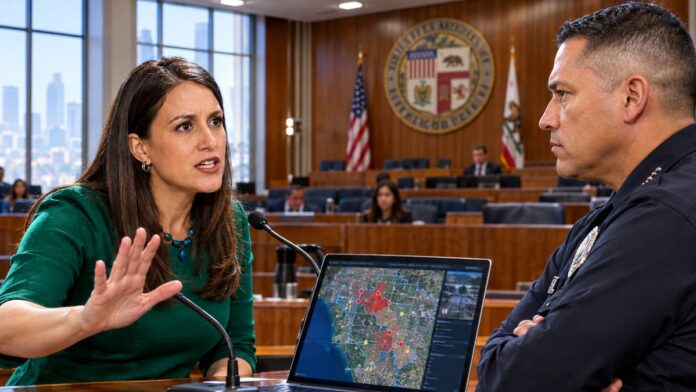
Los Angeles City Councilwoman Imelda Padilla pressed LAPD leadership during a recorded public meeting to create an early-warning system that would alert illegal immigrants and local businesses before federal immigration enforcement operations arrive in the city. The department refused, citing obstruction of justice.
The exchange unfolded as Padilla asked whether LAPD could deploy artificial intelligence or other technology to monitor the presence of federal agents operating near Los Angeles borders and issue advance alerts to prepare communities. She framed the request as support for businesses and the immigrant population, suggesting the department could track enforcement activity coming from neighboring areas such as Inglewood or the Antelope Valley.
An LAPD representative responded directly that the department could not fulfill the request. The officer asked Padilla to clarify whether she was seeking advance warning of enforcement actions by another agency. When she confirmed, the officer stated that complying would constitute obstruction of justice and advised her to consult the city attorney on the matter.
🚨HOLY SHT: I can't believe she really asked this out loud, in a recorded public meeting:
LA City Councilwoman Imellda Padilla asks the LAPD to warn illegals before ICE raids.
He tells her that would be obstruction and she should go speak with the city attorney🤣 pic.twitter.com/yA4CYsgqO5
— Unfiltered Under Trump (@HQ47Trump) October 14, 2026
The proposal centered on using technology to detect the movement of federal immigration agents and relay that information to city residents and businesses before enforcement actions could take place. Padilla described the idea as a creativity question and emphasized what she called the department’s loyalty to the City of Los Angeles. She asked what LAPD could do to warn the business community that federal agents were about to enter the city from outside jurisdictions.
The officer’s response was unambiguous. He confirmed that warning targets of an enforcement action by another agency before it happens would cross into illegal territory. The LAPD representative did not entertain debate on the question and directed Padilla to seek legal guidance from the city attorney if she wished to explore the matter further.
No follow-up actions or city attorney guidance emerged from the meeting record. The recorded exchange stands as a clear example of a local elected official attempting to involve city resources in shielding individuals from federal enforcement. Federal law treats interference with lawful immigration operations as a serious offense, and the officer’s response aligned with that standard by declining involvement.
The incident reflects broader tensions between local officials in sanctuary jurisdictions and federal immigration authorities. Padilla’s line of questioning sought methods for the department to prioritize what she framed as loyalty to Los Angeles by shielding residents from outside enforcement. The LAPD response underscored that such coordination would amount to illegal interference with federal operations.
Requests to preemptively notify targets of raids or enforcement actions run counter to the principle that local police should not impede lawful federal actions. Padilla’s public suggestion for technological alerts demonstrates an explicit effort to create early-warning systems for illegal immigrants facing potential removal proceedings. The officer’s firm rejection avoided any endorsement of obstruction while leaving the legal implications for city legal counsel to address.
The episode underscores patterns in certain California cities where elected officials have sought to limit cooperation with federal immigration authorities. Padilla’s proposal was not a private inquiry or theoretical discussion. It was a recorded public demand for LAPD to actively interfere with federal law enforcement by providing advance notice of immigration operations.
The LAPD representative’s response demonstrated clarity on the legal boundaries governing local law enforcement cooperation with federal agencies. The department declined to participate in a scheme that would alert targets of enforcement actions, recognizing the proposal as obstruction. Padilla was left to pursue the matter through the city attorney if she wished to challenge that assessment.
No statement from Mayor Karen Bass or the city attorney’s office addressing the exchange has been made public. The core question remains whether Los Angeles will officially explore legal avenues to implement the type of early-warning system Padilla proposed or whether the LAPD’s rejection will stand as the final word on the matter.
Sources
- Original post: Unfiltered Under Trump (@HQ47Trump) on X
- Related posts reviewed for this report:
- Leah Rain ✝️🇺🇸🎸🏝️ (@LeahRain77) on X, Oct 7, 2026
- @Chicago1Ray 🇺🇸 (@Chicago1Ray) on X, Jul 15, 2025
- Don Keith (@RealDonKeith) on X, Oct 14, 2026
Posts on X are shown as published by their authors; claims in them are attributed, not independently confirmed unless the article says so. If an embedded post does not load, these links open the originals.