


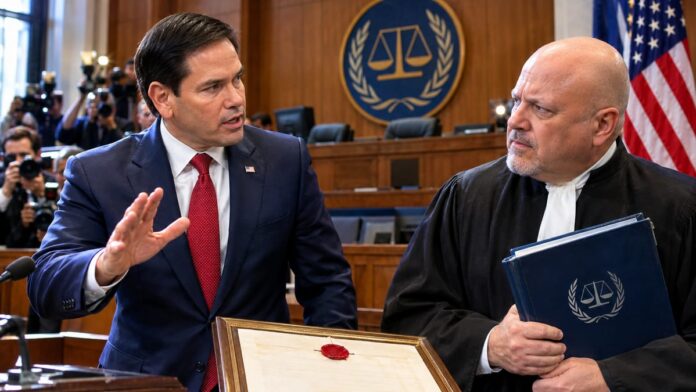
Trump Administration Sanctions ICC, Bans Transactions to Shield Americans from Prosecution
The Trump administration imposed sanctions on the International Criminal Court today, banning all transactions with the body and cutting off its financial resources in a direct move to prevent prosecution of American citizens, military personnel, and elected officials. Secretary of State Marco Rubio announced the action, describing the ICC as a rogue institution that operates without legitimate authority over the United States.
The sanctions follow decades of bipartisan rejection of the court’s jurisdiction. The United States never joined the ICC and has consistently opposed any claim of authority over American service members or political leaders. The new restrictions aim to cripple the court’s ability to pursue cases against U.S. interests by blocking financial transactions and limiting operational capacity.
Today, the Trump Administration is sanctioning the ICC.
This action should encourage our Allies within the Court to work for solutions to end this threat to U.S. sovereignty forever. pic.twitter.com/D86dCqLUaZ
— Secretary Marco Rubio (@SecRubio) October 9, 2026
Rubio made clear the administration’s position during the announcement. The court has expanded its ambitions to include potential prosecutions of Border Patrol agents defending national borders and officials responsible for national security policy. The administration views these efforts as overreach by distant globalist interests seeking power at the expense of American sovereignty.
President Trump stated he will never allow the ICC to prosecute Americans. The sanctions serve as immediate enforcement of that position. The message is direct: the United States and its citizens are not subject to ICC jurisdiction, and the administration labels the court a fake institution with no legitimate basis to act against non-member nations.
The decision also puts pressure on U.S. allies. Many allied nations participate in the ICC while simultaneously depending on American military forces for their own defense. The administration expects those allies to take internal steps to rein in the court’s activities. If they fail to act, the United States indicated it will continue dismantling the ICC piece by piece until threats to Americans cease.
The choice presented to the court is simple. The ICC must end its efforts against U.S. interests, or the United States will end the ICC. The sanctions ban represents the first concrete step in that campaign. By cutting off resources and transactions, the administration intends to restrict the court’s operational capacity and signal that attempts to prosecute Americans will meet sustained opposition.
This decision aligns with long-standing U.S. policy that rejects external judicial bodies claiming power over American citizens and armed forces. The administration argues sovereignty cannot be delegated to an unelected institution based overseas. The sanctions demonstrate concrete follow-through on protecting that independence through economic restrictions.
The ICC has previously attempted to investigate U.S. military actions and policy decisions. Those investigations met resistance from both Republican and Democratic administrations. The current sanctions go further than prior objections by imposing direct financial consequences designed to limit the court’s reach.
Rubio emphasized that both parties have historically agreed the ICC lacks authority over Americans. The difference, according to the administration, is resolve. The Trump administration claims it is the only one willing to take the necessary action to end the perceived threat permanently.
The court now faces a critical decision. It can abandon efforts to prosecute Americans and refocus on member-state cooperation, or it can continue and face sustained U.S. efforts to dismantle its operations. The sanctions make clear the administration will not tolerate attempts to subject American citizens to foreign judicial authority.
For allies participating in the ICC, the calculation is equally stark. They must choose between supporting the court’s expansive claims or maintaining the security relationship that keeps American forces stationed on their soil. The administration expects those nations to act internally to constrain the court, or face the consequences of continued U.S. countermeasures.
The sanctions represent a major escalation in the long-running conflict between the United States and the ICC over jurisdiction and authority. By targeting the court’s financial operations directly, the administration moves beyond diplomatic objections to concrete enforcement. The outcome will determine whether the ICC can maintain its current trajectory or whether sustained American opposition forces a fundamental shift in how the court operates.
Sources
- Original post: Secretary Marco Rubio (@SecRubio) on X, Oct 9, 2026
- Related posts reviewed for this report:
- ☀️✨ Rachel Speaks Out 🌙💜 (@Rachelspeakout1) on X, Oct 9, 2026
- Mario Nawfal (@MarioNawfal) on X, Oct 9, 2026
- Defence Dice (@DefenceDice) on X, Oct 9, 2026
Posts on X are shown as published by their authors; claims in them are attributed, not independently confirmed unless the article says so. If an embedded post does not load, these links open the originals.