


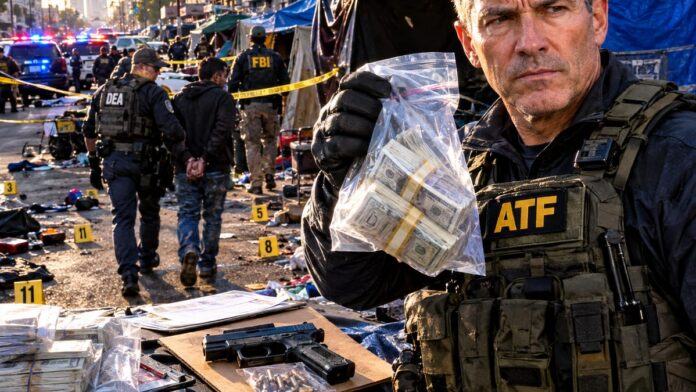
Federal Agents Seize Fentanyl, Cash, Firearms in Massive Skid Row Drug Bust
Hundreds of federal agents from the FBI, DEA, ATF, and U.S. Attorney’s Office joined the Los Angeles Police Department Thursday morning in a coordinated raid targeting drug trafficking operations on Skid Row. The operation resulted in 28 expected arrests, the execution of 44 search warrants across Los Angeles, and the seizure of large quantities of fentanyl, methamphetamine, cash, and firearms.
The predawn raid marked the culmination of a four-month undercover investigation into dealers selling poison on the streets of one of America’s most notorious open-air drug markets. By mid-morning, 14 suspects were in custody. Agents recovered substantial amounts of cash, firearms, and drugs from suspected stash houses and street-level dealers.
🚨 BREAKING: Hundreds of federal agents — FBI, DEA, ATF, U.S. Attorney's Office, and LAPD — are SWARMING Skid Row right now in a massive drug bust
28 arrests expected. 44 search warrants. Large wads of cash, firearms, and fentanyI being seized on scene.
Drug dealers are also… pic.twitter.com/W8Z3vPz1WA
— Nick Sortor (@nicksortor) October 8, 2026
Video from the scene showed officers processing evidence and detaining individuals. One man had large wads of cash removed from his pockets during arrest. Agents recovered a handgun from inside a tent. The scale of the operation reflected years of unchecked narcotics activity in the area.
ATF Special Agent in Charge Kenny Cooper addressed reporters on scene. His assessment was blunt. The conditions on Skid Row, he said, resembled a third world country rather than a major American city. Cooper described the ATF’s role in tracking how violent gang members with multiple felony convictions were obtaining firearms to protect their drug operations and settle rival disputes.
The investigation revealed a disturbing pattern. Drug dealers were deliberately timing their activity to coincide with the arrival of government assistance checks. Federal agents stated that traffickers targeted recipients on the specific days federal funds were deposited, preying on vulnerable individuals receiving public money.
Skid Row has functioned for years as a concentrated zone of homelessness, drug use, and violence. The area’s open-air market operates with a brazenness that has shocked even seasoned law enforcement. The presence of caged dogs at some raid locations added to the chaotic conditions agents encountered.
The coordinated federal-local response represents a direct effort to disrupt supply chains fueling the market. Agents emphasized their focus on violent offenders and the sources providing firearms to protect trafficking operations. Cooper’s team is working to identify trigger pullers and trace the supply lines funneling weapons into Skid Row for use in shootings tied to drug territory disputes.
The operation deployed hundreds of personnel across multiple agencies. The scale reflects the entrenched nature of the problem and the resources required to address it. Law enforcement officials described the action as a sustained push to restore order in an area where enforcement had previously been limited.
The bust comes as fentanyl overdoses continue to surge nationwide. Los Angeles County has seen record numbers of deaths tied to the synthetic opioid. Skid Row’s open-air market has functioned as a distribution point feeding addiction and death throughout the region.
Federal prosecutors are expected to file charges related to drug trafficking, firearms possession by felons, and conspiracy. The U.S. Attorney’s Office is leading the prosecution effort. Suspects face significant prison time under federal sentencing guidelines.
The raid underscores persistent challenges in addressing narcotics activity in urban centers where political will to enforce the law has wavered. For years, Skid Row has operated as a no-man’s land where dealers conducted business openly and violent crime proliferated unchecked.
Cooper’s assessment that the scene felt like a third world country was not hyperbole. The conditions on Skid Row represent a failure of governance and law enforcement at every level. The area has become a symbol of urban decay and the consequences of policies that tolerate open drug markets.
The operation’s success will be measured not just in arrests but in whether federal prosecution and long prison sentences disrupt the trafficking networks operating in the area. Short-term sweeps have proven ineffective in the past. Sustained enforcement and prosecution are required to break the cycle.
The involvement of multiple federal agencies signals a commitment to addressing the problem with resources local authorities have lacked. The DEA brings expertise in narcotics trafficking, the ATF in firearms tracing, and the FBI in organized crime investigation. Together, they represent a level of capability that can dismantle networks rather than simply arrest street-level dealers.
The timing of the raid before sunrise was deliberate. Agents aimed to catch suspects at stash houses before they could disperse or destroy evidence. The element of surprise proved effective, with cash and drugs recovered on site before traffickers could react.
The recovery of firearms during the raid highlights the violent nature of the trade. Dealers arm themselves to protect territory and product. Disputes are settled with bullets, often in public, with bystanders caught in crossfire. Cooper’s emphasis on identifying trigger pullers reflects the ATF’s focus on removing armed violent offenders from the streets.
The pattern of targeting government check recipients reveals the predatory nature of the operation. Dealers know when funds arrive and position themselves to extract that money through addiction. It is a calculated exploitation of the vulnerable, funded in part by taxpayer dollars.
Skid Row’s transformation into an open-air drug market did not happen overnight. It is the result of years of policies that decriminalized drug use, reduced enforcement, and tolerated disorder. The area has become a magnet for addiction, homelessness, and crime, creating conditions that shock even those who work in law enforcement.
Thursday’s raid represents a shift toward accountability and enforcement. Whether it marks the beginning of sustained action or a one-time show of force remains to be seen. The republic deserves better than neighborhoods that resemble third world countries. The test will be whether leaders follow through with prosecution and policies that restore order permanently.
Sources
- Original post: Nick Sortor (@nicksortor) on X, Oct 8, 2026
- Related posts reviewed for this report:
- F.A. United States Attorney Bill Essayli (@USAttyEssayli) on X, Oct 8, 2026
- U.S. Department of Justice (@TheJusticeDept) on X, Oct 8, 2026
- Eric Daugherty (@EricLDaugh) on X, Oct 8, 2026
Posts on X are shown as published by their authors; claims in them are attributed, not independently confirmed unless the article says so. If an embedded post does not load, these links open the originals.