


Private Equity’s Red Lobster History: How Wall Street Plundered American Retail and Left Workers With Nothing
Private equity firms destroyed Toys R Us, Red Lobster, Claire’s and dozens of other storied American brands through a predatory playbook that stripped billions from healthy companies while leaving workers with sixty-dollar severance checks.
The claire’s bankruptcy private equity case study reveals a pattern repeated across American retail. Investors buy a profitable company using borrowed money, shift the debt onto the business itself, extract hundreds of millions in management fees, then walk away as the company collapses under the weight of payments it never owed before the takeover.
I usually don’t agree with a lot of things @SenWarren says, but on this one she is 100% correct. Private equity has destroyed SO many storied brands. pic.twitter.com/Sfl3tYHJ6U
— Brian Stone (@briandstone) October 7, 2026
Toys R Us generated over eleven billion dollars in revenue when private equity purchased the company in 2005. The retailer was doing just fine. Over the next thirteen years, Toys R Us paid four hundred sixty-four million dollars in fees to its private equity owners. That money did not modernize stores, boost worker wages, or build an online presence to compete with Amazon. Instead, private equity fired thousands of employees, deferred maintenance, and let the infrastructure decay.
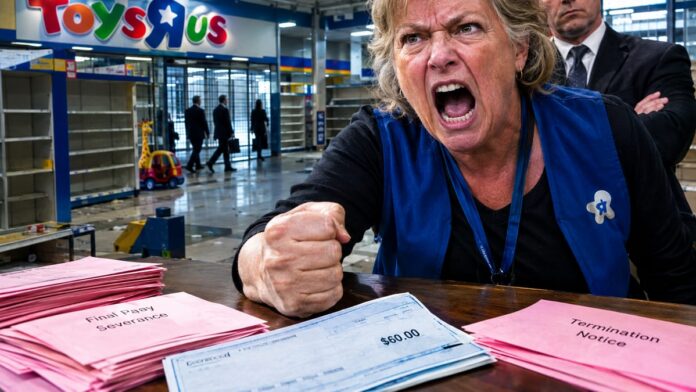
By 2017, Toys R Us filed for bankruptcy. The private equity firms made out like bandits. The CEO, a friend of the investors, collected a $2.8 million bonus. Workers who lost jobs and retirement plans received severance packages of sixty dollars per person. Sixty.
Mary Osmond, a former Toys R Us employee in Boardman, Ohio, told activists her story. She dedicated her life to the company and was left with nothing. At her age, no one would hire her. She called it disgusting.
The toys r us bankruptcy private equity fund model represents legalized looting. Companies taken over by private equity are ten times more likely to declare bankruptcy than independent businesses. The destruction is not accidental. For most acquisitions, bankruptcy was the plan all along.
Private equity asset stripping follows the same script every time. Investors march in, buy the company with borrowed funds, load it with debt, strip out assets, and suck money out until collapse. After thousands of workers are laid off, pensions raided, and stores shuttered, the private equity firms walk away with pockets stuffed with cash. There goes your local mall and all the stores you grew up with.
Red Lobster, Claire’s, Brookstone, Friendly’s, Petco, David’s Bridal, and Joann Fabrics all fell victim to the same playbook. These were not failing businesses rescued by savvy investors. They were profitable American companies gutted for short-term extraction.
At the time Toys R Us filed for bankruptcy, toy sales remained steady. Sales had stayed strong even during the Great Recession and in the year before the filing. What sank the company was the burden of payments owed to private equity. Brandon Ballew documents this in his book Plunder. The debt load and fee structure made failure inevitable regardless of consumer demand.
Executives whined that Amazon was to blame. The numbers tell a different story. The company was not crushed by competition. It was crushed by financial engineering designed to enrich a small group of investors at the expense of American workers and the communities that relied on those jobs.
Private equity asset management prioritizes quarterly returns for fund investors over the long-term health of the businesses they acquire. This approach accelerated the decline of physical retail spaces that anchored local economies for generations. Entire malls sit empty because private equity extracted value without building sustainable operations.
Washington has done very little to rein in these firms or align their incentives with the best interests of the American economy. As a result, private equity continues using legal tricks to get rich even when the companies they buy fail. The claire’s bankruptcy private equity fund case and the toys r us bankruptcy private equity case are not isolated incidents. They represent a systemic problem that continues unchecked.
Senator Elizabeth Warren calls this legalized looting. Her Stop Wall Street Looting Act aims to make these practices illegal. The bill has not passed. Meanwhile, private equity firms continue targeting American brands, and more workers will be left with nothing as storied companies collapse under manufactured debt.
The pattern is clear. Healthy companies with billions in revenue get bought with borrowed money. The debt gets transferred to the company’s books. Management fees flow to private equity owners for years. Maintenance stops. Workers get fired. The company goes bankrupt. Executives take bonuses. Workers get sixty dollars. Private equity moves to the next target.
This is not capitalism. This is asset stripping that hollows out the American economy one brand at a time. The firms responsible face no accountability. The workers they discard face poverty and betrayal after dedicating their lives to companies that were profitable until Wall Street showed up.
The republic deserves an economy that rewards building businesses, not destroying them. Until Washington acts, private equity will keep plundering, and American workers will keep getting sixty-dollar checks while executives walk away with millions.
Sources
- Original post: Brian Stone (@briandstone) on X, Oct 6, 2026
- Related posts reviewed for this report:
- Wall Street Apes (@WallStreetApes) on X, Apr 15, 2026
- Wall Street Apes (@WallStreetApes) on X, Oct 1, 2026
- Wall Street Apes (@WallStreetApes) on X, Nov 28, 2025
Posts on X are shown as published by their authors; claims in them are attributed, not independently confirmed unless the article says so. If an embedded post does not load, these links open the originals.