


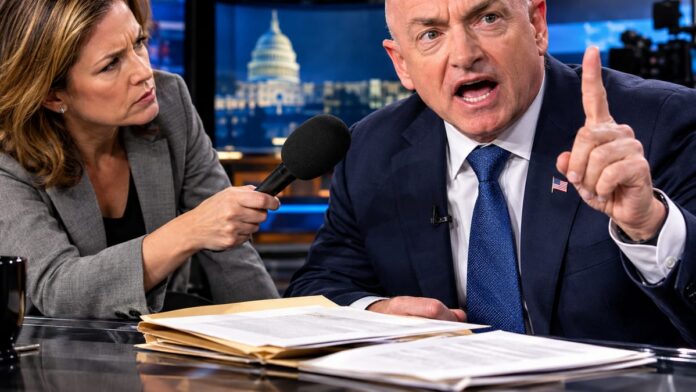
Senator Mark Kelly Admits Tax Hike Is His Affordability Plan
Arizona Democratic Senator Mark Kelly told CBS his strategy for lowering costs for American families is to raise taxes on higher earners.
In a recent interview, Kelly was asked how Democrats plan to make life more affordable. His answer was blunt. He outlined legislation he is working on with Maryland Senator Chris Van Hollen that would raise taxes for people making over one million dollars a year in income. The bill would provide tax cuts for individuals and couples earning up to roughly 160,000 dollars a year.
Mark Kelly says his plan to lower costs for Americans is to raise taxes.
KELLY: "We’re going to lower costs for the American people."
CBS: How?
KELLY: "I've got legislation with Chris Van Hollen…it raises taxes…” pic.twitter.com/GTod7Z7tjf
— RNC Research (@RNCResearch) October 4, 2026
Kelly framed the proposal as relief. He said Democrats need to win the House or Senate to pass it and acknowledged they would need Republican support. He positioned the plan as a way to shift the tax burden upward while delivering targeted cuts to middle-income households.
The remarks reflect a broader Democratic messaging strategy that treats tax increases as a tool for reducing household expenses. Progressive lawmakers have long argued that higher rates on the wealthy can fund relief elsewhere in the tax code. Kelly’s comments align with that framework.
Conservative economists have repeatedly shown that such proposals tend to reduce investment, slow job creation, and suppress wage growth across income levels. When marginal rates rise, capital moves offshore, hiring stalls, and the tax base shrinks. The revenue projections Democrats cite rarely materialize because the underlying assumptions ignore behavioral responses from businesses and high earners.
Kelly’s plan also leaves open significant questions. Households earning between 160,000 and one million dollars would see no direct benefit under the proposal. That bracket includes small business owners, dual-income families in high-cost states, and professionals navigating inflation and rising regulatory costs. The bill offers them nothing.
The emphasis on needing Republican support underscores the political reality facing the legislation. Republican-controlled chambers are unlikely to advance a bill built on tax increases. The party’s economic agenda centers on energy production, deregulation, and broad-based tax relief that stimulates growth rather than redistributes existing wealth.
Kelly’s comments also highlight a persistent divide in how the two parties approach affordability. Republicans argue that lowering energy costs, cutting red tape, and reducing the overall tax burden creates conditions for rising wages and lower prices. Democrats focus on government intervention through tax policy, spending programs, and price controls.
The timing of Kelly’s remarks is notable. Inflation remains elevated despite recent Federal Reserve rate hikes. Grocery prices, fuel costs, and housing expenses continue to squeeze household budgets. Voters consistently rank the economy and cost of living as top concerns heading into the 2026 midterm cycle.
Kelly is positioning himself as a moderate willing to work across the aisle. But the substance of his proposal reveals a reliance on progressive tax orthodoxy. The plan assumes that taking more from high earners and redistributing it through the tax code will ease financial pressure on working families. History suggests otherwise.
Prior administrations that pursued broad-based tax relief saw stronger economic growth, rising wages, and increased federal revenue through a larger tax base. The Trump tax cuts of 2017 delivered record-low unemployment, wage gains for lower-income workers, and sustained GDP growth until the pandemic. Those results came from reducing rates across the board and encouraging investment, not from punishing success.
Kelly’s legislation with Van Hollen continues a pattern in which Democratic lawmakers present tax hikes as essential to affordability. The framing is deliberate. By calling it relief, they hope to avoid the political cost of admitting they are raising taxes. But the math does not change. Higher rates on productive earners slow the economy. Slower growth means fewer jobs, lower wages, and less opportunity for the families Kelly claims to help.
The proposal also ignores the reality that many households earning over one million dollars are not passive wealth holders. They are business owners, investors, and entrepreneurs who employ workers, take risks, and drive innovation. Raising their taxes reduces the capital available for expansion, hiring, and wage increases. The burden does not stay at the top. It trickles down through the entire economy.
Kelly’s comments reveal the limits of Democratic economic thinking. The party continues to view the economy as a zero-sum game where one group’s gain requires another group’s loss. That worldview leads to policies that redistribute rather than grow the pie. It is a recipe for stagnation.
The contrast with Republican priorities could not be sharper. Energy independence, regulatory reform, and lower taxes create conditions for rising living standards without punishing success. That approach delivered results before and can again. Kelly’s tax-and-spend proposal offers only managed decline dressed up as relief.
Voters will decide in 2026 whether they want more government intervention or more economic freedom. Kelly’s interview made the stakes clear.
Sources
- Original post: RNC Research (@RNCResearch) on X, Oct 4, 2026
- Related posts reviewed for this report:
- Eric Daugherty (@EricLDaugh) on X, Oct 4, 2026
- Mr Producer (@RichSementa) on X, Oct 4, 2026
- Gunther Eagleman™ (@GuntherEagleman) on X, Oct 4, 2026
Posts on X are shown as published by their authors; claims in them are attributed, not independently confirmed unless the article says so. If an embedded post does not load, these links open the originals.