


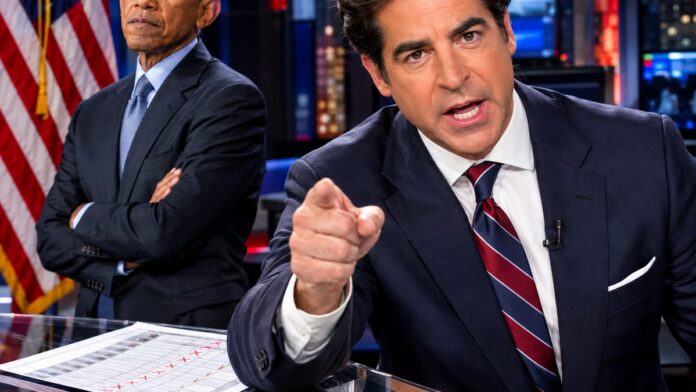
Jesse Watters Destroys Obama ‘Closer’ Myth with String of Democratic Losses
Fox News commentator Jesse Watters has dismantled the long-promoted narrative that Barack Obama serves as an effective closer for Democratic candidates, pointing to a documented pattern of high-profile losses that expose the myth.
Watters laid out the evidence plainly. Obama campaigned heavily in midterm elections where Democrats got hammered. He failed to close the deal for Kamala Harris. COVID kept him from helping Joe Biden directly, but when he did engage, results fell short. The list of candidates Obama personally backed who went on to lose is striking: Stacey Abrams lost twice in Georgia races, Terry McAuliffe lost in Virginia, Andrew Gillum lost in Florida.
NEW: OBAMA THE "CLOSER" HAS A LOSING STREAK LONGER THAN KAMALA'S PREGNANT PAUSES 🤣
Midterms? GOT KILLED. Kamala? COULDN'T CLOSE. Stacey Abrams? LOST TWICE 📉
"This guy does NOT have the golden touch everybody thinks he does" 🤦
Meanwhile Kamala is on a "self-improvement"… pic.twitter.com/yh7WthJV0H
— Jesse Watters (@JesseBWatters) October 6, 2026
The record speaks for itself. Democrats continue calling Obama the closer, but Watters asked the obvious question: How? When? Where? The golden touch reputation does not match electoral reality. Republicans turned out, and Obama’s endorsement failed to move the needle in race after race.
Watters contrasted Obama’s campaign schedule with Joe Biden’s whereabouts during critical stretches — Biden was spotted at a classic car show in Southern California while crucial races hung in the balance. The optics underscore a leadership vacuum Democrats have struggled to fill.
The commentary extended to Kamala Harris herself. Watters observed Harris has entered what he described as a self-improvement phase, focusing on sisterhood, hand-holding, and soul-searching. He warned against turning the White House into what resembles a yoga studio, arguing Americans need decisive leadership grounded in policy knowledge, not New Age California euphemism.
Watters identified a specific rhetorical pattern in Harris’s public remarks: pregnant pauses that appear designed to buy time while searching for substantive points. He described her speaking style as hallmarky mumbo-jumbo that masks a lack of depth on critical issues. Watters drew a sharp distinction between his own occasional pauses, which he said stem from having concrete points to make, and Harris’s pauses, which he characterized as empty stalling.
The analysis ties into broader conservative criticism of Democratic campaign strategy. Watters argued the party relies on celebrity surrogates and media narratives rather than substantive policy proposals that resonate with voters. The Obama closer myth represents one piece of that larger pattern — a reputation built on perception rather than measurable results.
Republican sources Watters cited indicated strong turnout could secure victories in contested races, suggesting the Democratic ground game and surrogate strategy have failed to counter organized Republican voter mobilization. The contrast between the two approaches has become clear in election after election.
Obama’s involvement in Democratic campaigns dates back over a decade, with mixed results even during his own presidency. The midterm losses Watters referenced were particularly severe, with Democrats losing control of the House in 2010 and the Senate in 2014. Those defeats came despite Obama’s active campaigning and high-profile endorsements.
The pattern continued in subsequent cycles. Stacey Abrams mounted two campaigns for Georgia governor, in 2018 and 2022, both ending in defeat despite Obama’s public support and fundraising assistance. McAuliffe’s 2021 Virginia gubernatorial loss came after Obama headlined rallies and cut campaign ads. Gillum’s narrow 2018 Florida defeat followed similar high-profile Obama involvement.
Watters framed these outcomes as evidence that Democratic voters and swing voters alike have moved past the Obama brand as a decisive factor. The closer nickname, once wielded as proof of Obama’s enduring political power, now rings hollow when measured against actual election results.
Harris’s current public posture adds another layer to the story. Her focus on personal growth and sisterhood language stands in stark contrast to the aggressive policy battles Republicans are waging on border security, crime, and economic issues. Watters suggested this approach signals a party struggling to find a message that connects with working-class voters who have shifted toward Republican candidates in recent cycles.
The pregnant pause critique cuts to communication style. Effective political communication requires clarity, confidence, and command of facts. Watters argued Harris displays none of those qualities when speaking extemporaneously, instead relying on vague platitudes and stalling techniques that telegraph uncertainty.
Democrats face a credibility problem heading into future election cycles. The Obama closer myth represented a reassuring talking point for the party — proof that they still had a secret weapon capable of energizing voters and closing tight races. Watters’s breakdown of Obama’s actual record strips away that comfort and forces a harder question: What happens when the myth no longer works?
Republicans have taken notice. The party has shifted from treating Obama endorsements as significant threats to viewing them as empty gestures that fail to move voters. That shift reflects broader changes in the American electorate, where celebrity endorsements and legacy political brands carry less weight than kitchen-table issues and demonstrated results.
The yoga studio warning about Harris carries real implications. Americans expect the White House to project strength, decisiveness, and competence on the world stage. A leader focused on soul-searching and self-improvement raises questions about priorities and readiness to handle crises.
Watters’s commentary reflects growing conservative confidence that Democratic messaging has lost its effectiveness. The party continues recycling the same surrogates, the same rhetoric, and the same assumptions about voter behavior, while Republicans have adapted to a changing political landscape.
The bottom line is results. Obama the closer has a losing streak that no amount of media spin can erase. Democrats who continue relying on his endorsement as a path to victory are ignoring clear evidence that voters have moved on.
Sources
- Original post: Jesse Watters (@JesseBWatters) on X, Oct 6, 2026
- Related posts reviewed for this report:
- RattleTrap 1776 (@derekjonhsonn) on X, Oct 7, 2026
- True Patriot Voice (@TruePatriotVox) on X, Oct 7, 2026
- GRANDPA’s FREE ADVICE (@GOP_is_Gutless) on X, Oct 7, 2026
Posts on X are shown as published by their authors; claims in them are attributed, not independently confirmed unless the article says so. If an embedded post does not load, these links open the originals.