


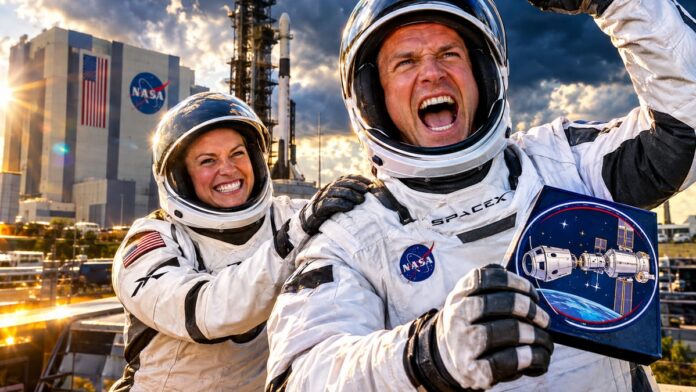
SpaceX Falcon 9 Booster Landing Reuse Rocket Powers Crew-13 to Station in Record Time
SpaceX launched four astronauts to the International Space Station aboard a Falcon 9 rocket Thursday morning, generating 1.7 million pounds of thrust from nine Merlin engines and delivering the crew to orbit in under eight hours. The Dragon spacecraft docked autonomously with the station using 16 Draco thrusters, marking the 21st crewed Dragon mission and demonstrating the reliability of American commercial spaceflight.
The Crew-13 mission carried two NASA astronauts, one Canadian Space Agency crew member, and one Russian cosmonaut. After the booster completed its job, it returned to Earth and landed upright on a recovery platform for reuse on future flights. This same booster will fly again, cutting costs and proving the sustainability of SpaceX’s rapid-turnaround model.
🚨 WATCH: SPACEX JUST BLASTED 4 ASTRONAUTS TO THE SPACE STATION 🚀🚨
1.7 MILLION POUNDS of THRUST… there in UNDER 8 HOURS 🤯
The ship DOCKED ITSELF — NO HUMANS NEEDED 🔥🔥
NASA Chief: Kids will "NEVER know a time when America could not launch its OWN ASTRONAUTS" 👨🚀 pic.twitter.com/GJaD9fsrcJ
— Jesse Watters (@JesseBWatters) October 2, 2026
The Dragon capsule reached the station in record time, faster than most crewed missions in recent years. It docked itself without human intervention, relying on automated systems and eight backup super engines that remain on standby for emergency abort scenarios. The crew will remain aboard the station for approximately six months, conducting experiments on plant growth, stem cell research, and preparing for spacewalks that advance long-duration mission planning.
NASA Deputy Administrator Matt Anderson emphasized the mission’s significance for the next generation of Americans. He stated that children watching today will never know a time when America could not launch its own astronauts to space. They will witness astronauts returning to the lunar surface and the beginnings of a moon base taking shape. Anderson projected a future where the United States operates a Space Academy and Americans watch their favorite astronaut set foot on another planet.
The Crew-13 launch was not SpaceX’s only activity Thursday. Later the same day, another Falcon 9 rocket lifted off from California through thick fog, deploying satellites and demonstrating the company’s ability to execute multiple complex operations within hours. This operational tempo underscores the maturity of SpaceX’s launch infrastructure and positions the United States ahead in the global space race.
Every successful mission builds practical experience that strengthens American capabilities in an increasingly competitive environment. China continues expanding its space station and lunar ambitions, while Russia maintains its decades-long presence in orbit. The United States now leads in commercial launch capacity, crew transportation, and reusable rocket technology.
NASA has approved three additional missions to map lunar resources and establish the groundwork for sustained human presence on the Moon. These flights will identify water ice deposits, test landing systems, and validate technologies required for surface operations. The Moon serves as a proving ground for Mars exploration, which remains the long-term objective of American space policy.
The Crew-13 astronauts will conduct dozens of experiments during their stay, including studies on how microgravity affects plant biology and human stem cells. These findings inform life-support systems for future deep-space missions. The crew will also perform spacewalks outside the station, testing equipment and procedures that could be used during lunar surface operations.
SpaceX’s reusable booster technology drives down the cost of access to space, enabling more frequent launches and accelerating scientific progress. The same booster that flew Thursday will undergo inspection, refurbishment, and return to the launch pad for another mission. This cycle repeats, building a fleet of flight-proven hardware that reduces reliance on new manufacturing.
Anderson’s remarks reflect confidence in America’s trajectory. The vision he described depends on continued investment, political will, and the partnership between NASA and private industry. The alternative is ceding leadership to adversaries who view space as a strategic domain and a symbol of national power.
The rapid docking time achieved by Crew-13 reflects improvements in orbital mechanics and spacecraft systems. Earlier missions required more than 24 hours to reach the station. Now, crews arrive the same day they launch, reducing time in cramped capsules and improving crew readiness upon arrival.
The autonomous docking capability removes human error from one of the most critical phases of spaceflight. The Dragon’s computers guide the approach, monitor clearances, and execute the final capture sequence without input from the crew. This frees astronauts to monitor systems and respond to contingencies rather than manually piloting the spacecraft.
America’s ability to launch its own astronauts was restored in 2020 after nearly a decade of dependence on Russian Soyuz vehicles. Since then, SpaceX has flown more than 20 crewed missions, establishing a safety record and flight rate that exceeds any other crewed spacecraft in history. The consistency of these launches signals that American human spaceflight is no longer experimental — it is operational.
The next generation will inherit a space program that is expanding, not contracting. They will see bases on the Moon, crews traveling to Mars, and potentially commercial space stations in orbit. The foundation is being built now, one launch at a time, with American ingenuity leading the way.
Sources
- Original post: Jesse Watters (@JesseBWatters) on X, Oct 1, 2026
- Related posts reviewed for this report:
- CBS Evening News with Tony Dokoupil (@CBSEveningNews) on X, Oct 1, 2026
- BIG DADDY (@AlexWestQ) on X, Oct 2, 2026
- SpaceX (@SpaceX) on X, Oct 1, 2026
Posts on X are shown as published by their authors; claims in them are attributed, not independently confirmed unless the article says so. If an embedded post does not load, these links open the originals.