


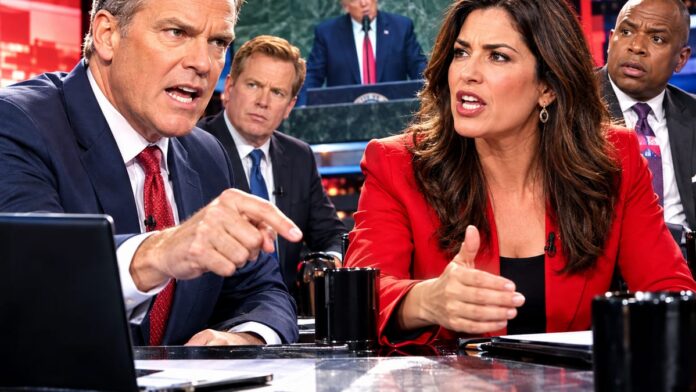
MSNBC Botches Live Fact Check During Trump UN Address, Fox Panel Calls It Activism
MSNBC faced sharp criticism from Fox News commentators after the network interrupted President Trump’s address to the United Nations with a fact check that turned out to be incorrect, forcing an on-air correction moments later. The panel, hosted by Trace Gallagher, called the episode a textbook example of activism masquerading as journalism and questioned why the network applies such scrutiny only to the sitting president while bypassing similar vetting for other sources.
Gallagher opened the discussion by highlighting the self-inflicted damage. The network cut away from Trump’s speech mid-address to challenge a claim about federal spending cuts, only to realize the correction itself was wrong. The resulting backtrack made the interruption look less like accountability and more like an attempt to score political points without doing the homework first. Gallagher noted that wanting to criticize the president is one thing, but botching the criticism on live television undermines any claim to credibility.
🚨 NEW: Fox News panel SLAMS MS Now for interrupting Trump’s U.N. speech with a failed ‘fact check’
Trace Gallagher: “I mean, the whole thing is you want to criticize the president and then you screw up the criticism. It’s a bad look when you get the fact and you have to… pic.twitter.com/Tei6wN8TNI
— TV News Now (@TVNewsNow) September 23, 2026
Shirin Yadegar, founder of LA Mom Magazine, pressed the broader point about consistency. If a network is going to interrupt a sitting president with real-time fact checks, she argued, the same standard must apply across the board. She pointed out that MSNBC has historically run with information from the t*rrorists health ministry in Gaza without immediate on-air scrutiny and accepted New York Times reporting without similar live interruptions. The question, Yadegar said, is why only Trump gets this treatment. Journalism schools teach objective reporting, she added, not activism disguised as accountability. If a network is going to deploy gotcha moments, the facts need to be airtight. In this case, they were not.
Gallagher reinforced the tactical problem. Cutting away from a major international address every time a network disagrees with the speaker would make any extended speech unwatchable. He argued that the proper approach is to air the full remarks and then analyze them afterward, rather than inserting partisan commentary in the middle. The interruption strategy, he suggested, is less about informing viewers and more about ensuring the network gets the last word before the president finishes speaking.
Jeff Vaughn, anchor of the LACA streaming channel, agreed that fact-checking itself is not the issue. Politicians from both parties make claims that deserve scrutiny. The problem, Vaughn said, is the timing and the motive. The interruption felt less like journalism and more like an attempt to seize control of the narrative before the speaker could make his full case. Vaughn described the behavior as typical of media elitists who assume they know better than conservative figures and rush to insert their own framing before the audience can hear the argument in full. In this instance, he said, the tactic looked silly and childish.
The panel’s criticism centered on the double standard. MSNBC has aired statements from foreign governments, opposition groups, and unnamed sources without similar real-time challenges. The network has quoted reports from outlets with documented bias without pausing to fact-check them on air. Yet when the president of the United States addresses the General Assembly, the network treats the moment as an opportunity to interrupt and correct in real time. The fact that the correction itself required correction only magnified the appearance of bias.
The failed interruption raised questions about editorial priorities. Viewers watching a presidential address to the United Nations expect to hear the full speech and evaluate it themselves. A network that cuts away mid-speech to deliver a rushed fact check signals that it does not trust its audience to process the information without immediate guidance. When the fact check itself is wrong, the message becomes even clearer. The network is not facilitating informed debate. It is trying to control the conversation.
The episode also exposed the risk of treating live presidential remarks as opportunities for real-time commentary rather than news events that warrant full coverage. Major addresses to international bodies are moments of public record. They set policy, signal diplomatic priorities, and shape global perceptions of the republic’s leadership. Interrupting such a speech to deliver a partisan talking point, especially one that turns out to be inaccurate, diminishes the network’s role as a news organization and reinforces the perception that editorial decisions are driven by ideology rather than journalistic standards.
The Fox panel made clear that the problem is not fact-checking itself. The problem is selective fact-checking applied inconsistently and executed poorly. If MSNBC wants to position itself as a network that holds power accountable, Yadegar argued, it must apply the same standard to all sources. If it wants to interrupt speeches with real-time corrections, Gallagher added, it must ensure those corrections are accurate. Otherwise, the interruption becomes the story, and the network’s credibility becomes the casualty.
The incident follows a broader pattern of networks treating Trump differently than other political figures. Real-time fact checks, on-screen chyrons disputing claims, and mid-speech interruptions have become routine during Trump addresses but remain rare during speeches by Democratic leaders. The inconsistency fuels accusations of bias and undermines public trust in institutions that claim to report the news without favoritism.
The failed MSNBC fact check will likely reinforce the view among conservative audiences that major networks are less interested in objective reporting than in advancing a preferred narrative. When a network cuts away from a presidential address to deliver a correction that itself requires correction, the message to viewers is unmistakable. The goal was not accuracy. The goal was interference. And in this case, the interference backfired.