


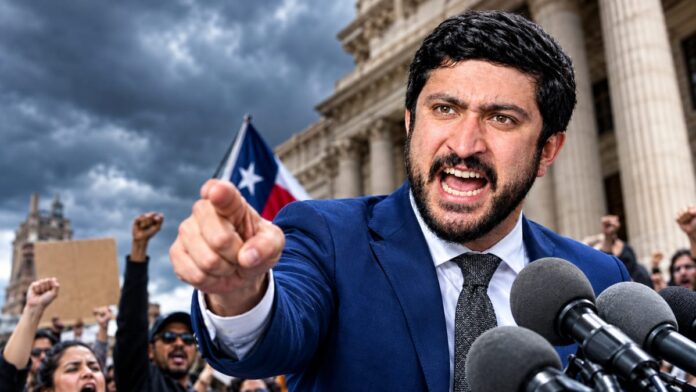
Congressman Tells ICE to Leave Austin After Blaming Federal Agents for Shooting
U.S. Congressman Greg Casar stood at a microphone in North Austin and told Immigration and Customs Enforcement agents to end their operations in his city, framing the presence of federal law enforcement as the cause of violence rather than the criminal activity tied to unlawful presence in the country. The Democrat representing Texas’s 35th district delivered his remarks as protesters gathered behind him, blaming ICE for a shooting incident and demanding the agency withdraw from the community.
Casar’s statement came in response to an ICE operation in North Central Austin. He described the federal enforcement action as an unwelcome surge and warned that the presence of ICE agents would lead to shootings similar to incidents he cited in Minneapolis, Corpus Christi, and Chicago. He declared that the day he had warned about had arrived and urged ICE to leave for Austin to be safe. His position treats lawful federal immigration enforcement as a threat to public safety while ignoring the statutory authority Congress has granted ICE to operate nationwide.
Watching members of Congress fight for illegals over Americans is getting really old. https://t.co/6ewMxkZQLL
— Spitfire (@RealSpitfire) September 21, 2026
Federal law gives Immigration and Customs Enforcement clear authority to carry out its duties across the United States. The Supremacy Clause of the Constitution establishes that federal law overrides state and local ordinances when the two conflict. Immigration enforcement falls under federal jurisdiction, meaning elected officials at the state, county, or city level do not have legal standing to block or nullify ICE operations. When a sitting member of Congress publicly calls for federal agents to end enforcement in his district, he signals to constituents that compliance with immigration statutes is optional and that local sentiment can override national law.
Casar’s remarks reflect a broader pattern among some lawmakers who treat federal immigration law as negotiable. Resistance to ICE operations often frames enforcement as the problem rather than the unlawful entry and presence the law addresses. American taxpayers fund public services stretched by illegal immigration, including schools, emergency rooms, housing assistance, and law enforcement. When representatives advocate for shielding individuals present unlawfully from removal, they prioritize non-citizens over the citizens who elected them and whose tax dollars pay for the services those individuals use.
The congressman’s statement that ICE should leave Austin for the city to be safe inverts the actual source of danger. Federal agents enforce laws passed by Congress. Criminal activity tied to unlawful presence, including identity fraud, document forgery, smuggling, and in some cases violent crime, is what threatens communities. ICE operations target individuals who have violated immigration statutes, many of whom have additional criminal records. Blaming the enforcement of the law for violence that occurs during an arrest shifts responsibility from the lawbreaker to the officer carrying out a lawful duty.
Critics argue that elected officials who openly advocate ignoring federal statutes passed by Congress undermine the rule of law and should face removal from office along with legal accountability. When a congressman tells a federal agency to stop enforcing the law in his district, he is not defending his constituents. He is defending individuals who have no legal right to be in the country and whose continued presence strains the resources meant for American citizens. The separation of powers does not grant him authority to nullify federal immigration enforcement.
Casar’s call for ICE to end its surge in Austin came as he stood surrounded by supporters who had gathered to protest the operation. His rhetoric treats federal law enforcement as an occupying force rather than an agency carrying out its congressionally mandated mission. The framing suggests that local preference should override national immigration policy and that enforcement itself, not unlawful presence, is the crisis.
The statement that ICE agents should leave before someone is shot places blame on the presence of law enforcement rather than on resistance to lawful arrest. When individuals flee from or physically resist federal agents, the danger escalates. The solution is not to tell agents to leave. The solution is to comply with the law. A congressman who encourages non-compliance with federal immigration enforcement encourages lawlessness.
Federal authority exists to maintain border integrity and enforce immigration statutes uniformly across the republic. Efforts to obstruct ICE through rhetoric, non-cooperation, or public pressure clash with the constitutional framework that places immigration matters under national control. When local leaders or members of Congress urge resistance to federal enforcement, they invite selective application of the law, erode respect for legal processes, and send a message that American sovereignty is negotiable.
The frustration voiced by Americans over elected officials prioritizing illegal immigrants above citizens continues to grow. Watching members of Congress advocate for those present unlawfully while American communities absorb the costs in housing, schools, public safety, and social services has grown tiresome. Enforcement of existing law remains essential. Continued resistance only prolongs the imbalance, leaving citizens to bear the consequences of policies that place unlawful entrants first.
Congressman Greg Casar told ICE to leave Austin. He blamed federal agents for violence. He stood with protesters demanding an end to enforcement. His position treats federal immigration law as optional and local sentiment as supreme. That position is not just wrong. It is a dereliction of duty and a denial of the constitutional structure that places immigration under federal control. Americans elected him to represent their interests, not to shield lawbreakers from the consequences of violating statutes passed by Congress.