
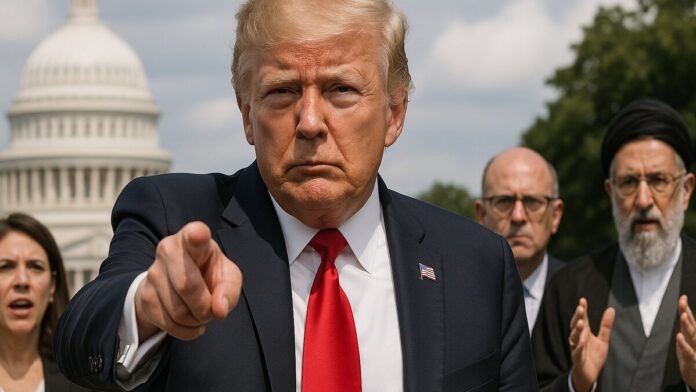
The United States Ambassador to the United Nations has delivered an unmistakable warning to Iran’s ruling regime: President-elect Donald Trump will not tolerate the Islamic Republic’s continued threats to global energy security and economic stability.
In forceful remarks that underscore the incoming administration’s hardline approach toward Tehran, the ambassador declared that Trump “is not messing around” and “stands, unlike his predecessors, by his red lines.” The diplomat made clear that the president-elect will not allow Iran’s “genocidal regime to hold the world’s energy supplies or economies hostage.”
.@USAmbUN on Iran: "The president is not messing around. He stands, unlike his predecessors, by his red lines, and he's not going to allow this genocidal regime to hold the world's energy supplies or economies hostage." pic.twitter.com/QfQ0A9w0kK
— Rapid Response 47 (@RapidResponse47) March 22, 2026
The statement comes as Iran continues to leverage its strategic position controlling the Strait of Hormuz, through which 21 percent of the world’s seaborne oil flows daily. Recent Iranian-backed Houthi attacks on Red Sea shipping have already disrupted 12 percent of global trade, forcing vessels to take costly detours around Africa.
The ambassador specifically highlighted the role of Iran’s Islamic Revolutionary Guard Corps (IRGC), which the United States designated as a foreign terrorist organization during Trump’s first term. “The IRGC, which we declared a terrorist organization, along with many European countries, control much of Iran’s economy, control its critical infrastructure, and continue to power what’s left of its war effort through this control of its critical infrastructure,” the ambassador stated.
This economic stranglehold extends across virtually every sector of Iranian society. From oil refineries and ports to telecommunications networks and construction conglomerates, the IRGC’s tentacles reach deep into the country’s infrastructure. These revenues directly fund Iran’s proxy terror network, including Hezbollah in Lebanon, Hamas in Gaza, and Houthi rebels in Yemen.
Trump’s previous “maximum pressure” campaign demonstrated the effectiveness of targeted economic warfare against Iran’s regime. Under his administration, crippling sanctions slashed Iran’s oil exports by over 80 percent, starving the regime of the petrodollars needed to sustain its regional terror operations. Iran’s economy contracted sharply, with inflation soaring past 40 percent and the rial plummeting to historic lows.
The contrast with previous administrations could not be starker. The Obama-era Joint Comprehensive Plan of Action funneled over $150 billion in sanctions relief directly to Tehran. That windfall supercharged Iran’s malign activities across the Middle East. Ballistic missile tests proliferated, uranium enrichment accelerated toward weapons-grade levels, and attacks on U.S. forces in Iraq intensified.
President Biden’s attempts to revive the nuclear deal only emboldened the ayatollahs further. Iran now operates advanced centrifuges at Fordow and Natanz facilities, enriching uranium to 60 percent purity – just a technical step from bomb-grade material. The International Atomic Energy Agency reports Iran possesses enough fissile material for nine potential warheads, with breakout capacity potentially within weeks.
Trump’s red lines are forged from hard-learned lessons and proven results. During his presidency, he ordered the precision strike that eliminated Qasem Soleimani, the IRGC Quds Force commander responsible for the deaths of hundreds of American service members. That operation decapitated Iran’s terror command structure and sent an unmistakable message across the region.
Iran’s feeble response – a missile barrage on U.S. bases in Iraq that caused no American fatalities – exposed the regime’s fundamental weakness when confronted with decisive American action. The strike sparked domestic protests within Iran, with citizens chanting “Death to the IRGC” as economic pressures mounted.
The ambassador’s characterization of Iran as a “genocidal regime” reflects the Islamic Republic’s openly stated goals. Supreme Leader Ali Khamenei routinely calls for Israel’s complete annihilation, labeling the Jewish state a “cancerous tumor” that must be eradicated. Billions in Iranian funding sustained Hamas’s October 7, 2023 massacre, where 1,200 Israelis were slaughtered and 250 taken hostage.
Hezbollah’s arsenal of 150,000 rockets, largely Iranian-supplied, poses an existential threat to Israeli population centers. In Syria, IRGC-backed militias continue propping up Bashar al-Assad’s brutal regime. Iraqi Shia militias under Tehran’s influence regularly launch drone strikes against U.S. forces. Yemen’s Houthis, armed with Iranian precision-guided munitions, have transformed from a regional insurgency into a global maritime menace.
This axis of Iranian aggression stretches from Tehran to the Mediterranean, holding entire economies hostage through calculated disruptions of critical shipping lanes and energy infrastructure. Recent Houthi attacks have forced major shipping companies to reroute around Africa, adding weeks to delivery times and billions in additional costs.
Trump’s return signals a fundamental reversal of this appeasement approach. Unlike predecessors who negotiated from positions of weakness – Obama’s secret pallets of cash flown to Tehran, Biden’s unfreezing of $6 billion for supposed “humanitarian” use even as Hamas launched its rampage – Trump wields economic pressure as both precision instrument and overwhelming force.
Expected policy changes include a resurgence of secondary sanctions targeting Chinese and Russian entities that continue purchasing Iranian oil in violation of international restrictions. Designations against IRGC-linked shipping firms, already disrupting Tehran’s “ghost fleet” operations, will intensify significantly. Enhanced intelligence sharing with regional allies will target the financial networks sustaining Iran’s proxy operations.
Diplomatically, Trump can rally Gulf Arab states, who view Iran as an existential threat, into a unified front against Tehran’s regional ambitions. Saudi Arabia, after suffering its own devastating Houthi drone strikes on critical oil infrastructure, stands ready for deeper security cooperation with both Israel and the United States.
The global economy hangs in the balance as this confrontation escalates. Europe’s ongoing energy crisis, exacerbated by Russia’s invasion of Ukraine, leaves the continent particularly vulnerable to Iranian-orchestrated supply disruptions. Asian economies, which consume roughly 80 percent of oil flowing through the Strait of Hormuz, face potential supply shocks that could derail economic growth across the region.
America’s shale oil revolution provides some insulation from these pressures while positioning the United States as a critical alternative supplier. Trump’s energy dominance policies – unleashing liquefied natural gas exports and maximizing domestic production – can flood global markets to undercut OPEC+ manipulation, including Iran’s 3.5 million barrel daily quota.
Critics argue this confrontational approach risks dangerous escalation, but recent history vindicates the effectiveness of sustained pressure. During Trump’s first term, Iran temporarily suspended certain nuclear activities under economic duress, and Iranian proxy groups significantly reduced their operational tempo. The Soleimani elimination created lasting deterrent effects that persisted for years.
Economically, Iran’s GDP contracted by 7 percent in 2019 alone, forcing budget cuts that severely weakened the regime’s military posture and regional influence. Public unrest swelled dramatically, with the 2019-2020 protests seeing security forces kill over 1,500 demonstrators as the regime struggled to maintain control. Women-led movements against mandatory hijab laws and endemic corruption signal internal rot that external pressure can effectively exploit.
Looking ahead, Trump’s red lines extend beyond energy security to encompass Iran’s nuclear weapons program entirely. He has repeatedly vowed that no Iranian nuclear weapons will be tolerated during his presidency, whether through “snapping back” UN sanctions via existing JCPOA mechanisms or implementing comprehensive unilateral measures.
Military options remain firmly on the table, ranging from sophisticated cyber operations designed to cripple uranium enrichment facilities – building on past Stuxnet successes – to potential airstrikes targeting critical nuclear infrastructure. Regional allies like Israel, emboldened by Trump’s unwavering support, stand ready to act. Prime Minister Benjamin Netanyahu has publicly praised Trump’s moral clarity in confronting “fanaticism and terror.”
The ambassador’s declaration represents more than diplomatic rhetoric – it signals a fundamental shift toward confronting Iran’s malign influence through sustained pressure rather than failed accommodation. As global energy markets brace for potential disruption, America under Trump prepares to lead from strength rather than negotiate from weakness.
For Iran’s ruling clerics, the message could not be clearer: the era of holding the world economy hostage is ending. Trump’s red lines are not empty threats but promises backed by proven resolve and overwhelming capability. The ayatollahs’ decades-long strategy of leveraging energy blackmail and proxy terror to extract concessions faces its greatest challenge yet.
The world watches as two fundamentally opposed visions of global order prepare for collision – Iran’s axis of resistance through terror and extortion versus America’s commitment to free markets and secure energy flows. In this confrontation, the ambassador has made America’s position unmistakably clear: Trump is not messing around.